
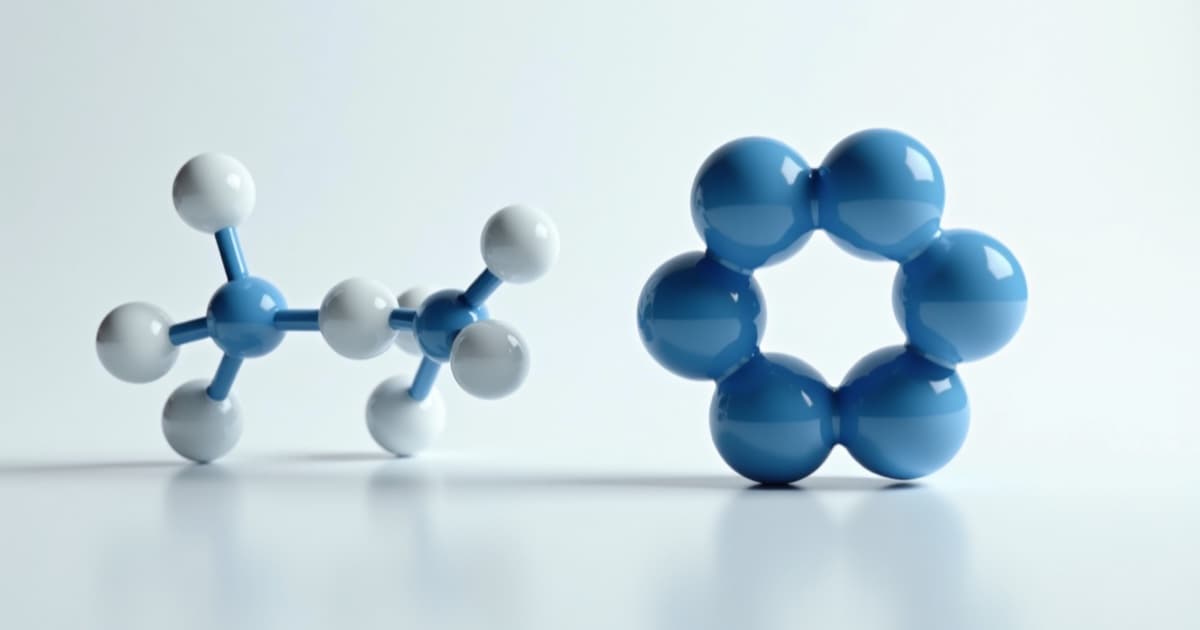
Closing a peptide into a ring changes two things at once: what can attack it, and what shape it can take. A linear peptide has two free ends for exopeptidases to work on and a backbone free to flex through many conformations. A cyclic one has no ends and a constrained backbone. Both consequences are usually wanted, and the second is the more interesting, because it is the one that changes how a receptor sees the molecule.
Three ways to close a ring
| Closure | Bond formed | Mass change | Example in the catalogue |
|---|---|---|---|
| Head-to-tail | Amide between the N- and C-termini | −18 Da (loses water) | None; common in natural products |
| Side-chain lactam | Amide between a Lys and a Glu/Asp side chain | −18 Da | Melanotan-2 |
| Disulphide | S–S between two cysteines | −2 Da (loses two H) | Amylin analogues, AOD-9604 |
The mass column is worth noticing because it is how cyclisation shows up on a certificate. A lactam-cyclised peptide weighs eighteen units less than its linear precursor, a disulphide-closed one two units less. A mass matching the linear calculation means the ring did not form — which for a disulphide is a real and common failure, discussed on its own.
Why does a ring resist proteases?
Two reasons, one obvious and one less so. Exopeptidases need a free terminus to start from; head-to-tail cyclisation removes both, and a side-chain lactam or disulphide removes neither but ties the chain so the ends cannot be threaded into an active site. Endopeptidases cut internally and need the backbone to adopt an extended conformation across their cleavage groove; a ring holds the backbone in a shape that often cannot. Neither protection is absolute — a large ring with a flexible stretch can still be cut — but the gain is usually substantial, which is why cyclisation sits alongside capping and substitution as a stability strategy.
Why does a ring change receptor binding?
Because a receptor recognises a shape, and a linear peptide does not hold one. In solution a short linear sequence samples many conformations, only some of which fit a binding pocket; the energy cost of adopting the right one is paid at binding, which lowers affinity. A ring that already holds the binding conformation pays that cost in advance, and affinity rises. This is the general principle, and it has a corollary: a ring that holds the wrong conformation kills binding entirely. Cyclisation is not a stability trick with a free affinity bonus; it is a bet on a shape.
What the constraint does to selectivity
The expectation is that constraining a peptide should make it more selective — one shape, one receptor. It often works that way, and it sometimes does the opposite, and Melanotan-2 is the standing example. Its lactam ring locks a conformation that four melanocortin receptors all accept, so the cyclic compound is broader than the linear one. The lesson is that selectivity is a property of the receptor family's shared geometry as much as of the ligand, and it cannot be predicted from the fact of cyclisation. It has to be measured.
Are cyclic peptides harder to make?
Yes, and the difficulty shows up as cost and as impurities. The ring-closing step competes with the same reaction happening between two molecules instead of within one, giving dimers and oligomers that must be removed. Ring size matters: very small rings are strained and form poorly, very large ones close slowly and cyclise between molecules more readily. A lactam formed on the resin needs orthogonal protecting groups so only the intended side chains react. The synthesis is therefore longer, the crude product dirtier, and the purification more demanding, all of which is why a cyclic analogue costs more than a linear one of the same length.
Does a cyclic peptide handle differently in the laboratory?
Mostly better, with one exception. It resists exopeptidases in culture medium, so timing between addition and readout is a smaller variable than for a linear peptide. It is often more rigid and less prone to sheet-forming aggregation, because the backbone cannot extend into the conformation sheets need. The exception is disulphide-closed rings, which are stable against proteases but chemically vulnerable: reducing agents open them, alkaline pH lets them exchange, and for any peptide with more than one bridge the wrong connectivity is a real impurity that mass cannot detect. A lactam ring has none of those problems and is the more robust closure where the chemistry allows it.
How can I tell from a sequence whether a peptide is cyclic?
Look for the notation. A lactam is often written with a bracket spanning the two residues it joins, or with the residues marked — the melanotan-2 sequence carries a "cyclo" designation between its aspartate and lysine. A disulphide is implied by two cysteines and is usually stated explicitly on a certificate as "one disulphide bridge" or similar. A head-to-tail ring is written as cyclo(…) around the whole sequence. Where none of that appears, assume linear, and check the certificate's identity panel: the mass will say, because the ring costs eighteen or two units and the bare sequence sum does not.
Does cyclisation change how a peptide should be stored?
Only for disulphide rings, and there it changes a great deal. A lactam or head-to-tail ring is an ordinary amide bond and needs nothing beyond the usual cold, dark, aliquoted storage. A disulphide ring is a chemical bond that reducing agents open and free thiols exchange, so buffers have to be checked for DTT or β-mercaptoethanol and kept at or below neutral pH. The distinction is easy to miss because both are called cyclic, and only one of them can quietly stop being cyclic in the tube.
All products referenced here are supplied for laboratory and research use only. They are not drugs, foods, supplements or cosmetics, and are not for human or veterinary use.