GHK-Cu is not a peptide with copper added as an afterthought — the copper is the point. The tripeptide glycyl-L-histidyl-L-lysine binds a copper(II) ion with high affinity, and it is the complex, not the bare peptide, that the literature describes. That single fact explains the colour of the solution, the handling constraints, and why a certificate for GHK-Cu has to report something certificates for ordinary peptides never mention.
Three residues and one metal ion
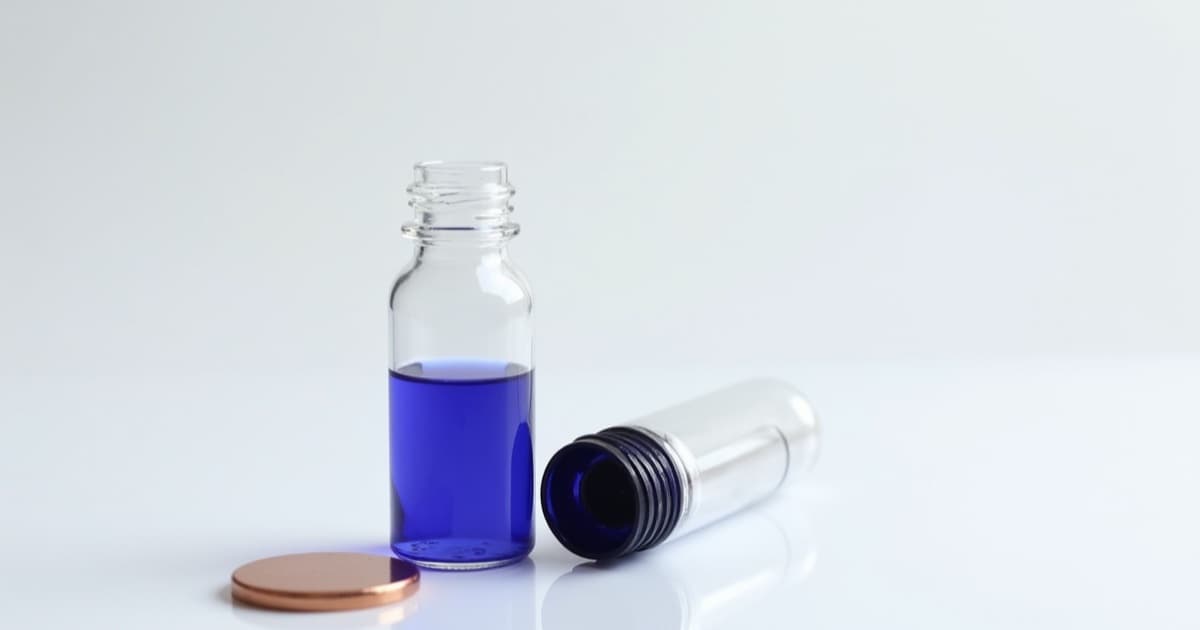
Glycine, histidine, lysine. At three residues it is close to the shortest thing that can meaningfully be called a peptide, and its behaviour comes almost entirely from the histidine imidazole and the free amino terminus, which together form a coordination site for copper. The affinity is high enough that GHK will strip copper from weaker carriers, and the resulting complex is the blue-to-purple species seen in solution.
Copper in free ionic form is reactive and generates radicals; bound in a defined coordination geometry it is held in a controlled state. The interesting proposal about GHK-Cu is that it behaves as a copper delivery and exchange vehicle — moving the ion between binding partners rather than simply carrying it — which is a different kind of claim from the receptor pharmacology that describes most peptides.
Why is the copper part of the name?
Because GHK and GHK-Cu are not interchangeable. The uncomplexed tripeptide and the copper complex are different chemical species with different properties, and a paper studying one does not automatically describe the other. A product labelled simply "GHK" may be the copper-free peptide, which will scavenge copper from whatever is available in a buffer — making the actual species in the experiment a function of the medium rather than of what was weighed out. Where the literature says GHK-Cu, the complex is what was meant.
What does a GHK-Cu certificate need to show that others do not?
Copper content, and the stoichiometry. Purity and identity answer the usual questions about the peptide, but neither confirms that copper is present at the intended one-to-one ratio. A batch can be a chemically excellent tripeptide and be under-complexed. The figure worth looking for is a copper determination, and the identity confirmation should describe the complex rather than the free peptide — the mass differs by the copper ion minus the protons it displaces. Reading the panels for what each one actually proves matters more here than for a single-component peptide.
Where the proposed activity comes from
Two strands, and they are different in kind.
Copper-dependent enzymes. Several enzymes central to extracellular matrix chemistry require copper as a cofactor — lysyl oxidase, which cross-links collagen and elastin, is the most cited. A molecule that influences local copper availability could in principle influence the activity of those enzymes, which is a mechanism operating through metal handling rather than through a receptor.
Gene expression changes. A body of work reports broad transcriptional changes in cultured fibroblasts on exposure to GHK-Cu, with matrix remodelling genes among those affected. This is the more frequently cited strand and the one that needs the most care: a wide transcriptional signature is a description of what changed, not an explanation of how, and a copper complex is capable of producing changes through metal chemistry alone.
Is GHK-Cu a signalling peptide or a copper carrier?
The honest answer is that the distinction has not been cleanly resolved, and it is the central question in reading this literature. There is no established receptor for GHK-Cu in the way there is for an incretin or a melanocortin. If the activity is copper handling, then the peptide is a delivery vehicle and the comparator is other copper complexes. If there is a distinct peptide-mediated component, it should be separable from copper delivery experimentally. Papers that include a copper-only control are considerably more informative than those that do not, and that control is often absent.
Handling, where it differs from an ordinary peptide
The copper complex introduces constraints that do not apply to most vials in a freezer.
| Factor | Why it matters for GHK-Cu |
|---|---|
| pH | Coordination is pH-dependent; strongly acidic conditions can dissociate the complex |
| Chelators | EDTA and similar buffer components compete for copper and can strip it |
| Reducing agents | DTT and β-mercaptoethanol reduce Cu(II) and change the species present |
| Colour | The blue-purple tint is the complex; loss of colour is a visible signal something changed |
| Light and air | Copper complexes catalyse oxidation chemistry; minimise exposure |
Does the solution colour tell you anything useful?
More than for most compounds, and it is the only free diagnostic on this list. The characteristic tint belongs to the copper complex, so a GHK-Cu solution that is colourless, or that has shifted markedly, is reporting that the coordination environment is not what it was. It is a qualitative signal rather than a measurement — it will not reveal partial dissociation — but a peptide that announces a chemical change by changing colour is unusual, and worth noticing rather than ignoring.
Why does GHK-Cu appear in blends so often?
Because its proposed mechanism sits in matrix chemistry, which is a different layer from the angiogenic and cytoskeletal mechanisms proposed for the compounds it is usually combined with. Glow and KLOW both pair it with those, on the logic that the mechanisms are non-overlapping — what is in each, and at what ratio, is worth reading before assuming. The same caution applies as to any co-formulation: the ratio is fixed at manufacture, and a copper complex sharing a vial with other peptides is sharing a single set of pH and buffer conditions, which the complex is more sensitive to than they are. Separate vials of GHK-Cu keep those conditions under your control.
Is more copper better?
No, and this is where the chemistry pushes back hardest on intuition. The complex is defined by a stoichiometry; copper beyond it is free ionic copper, which is exactly the reactive species the complex exists to hold in check. Free copper participates in Fenton-type chemistry and generates radicals. A preparation carrying excess copper is not a stronger version of GHK-Cu, it is GHK-Cu plus a contaminant with its own reactivity — which is the reason the copper figure on a certificate is worth finding rather than assuming.
All products referenced here are supplied for laboratory and research use only. They are not drugs, foods, supplements or cosmetics, and are not for human or veterinary use.