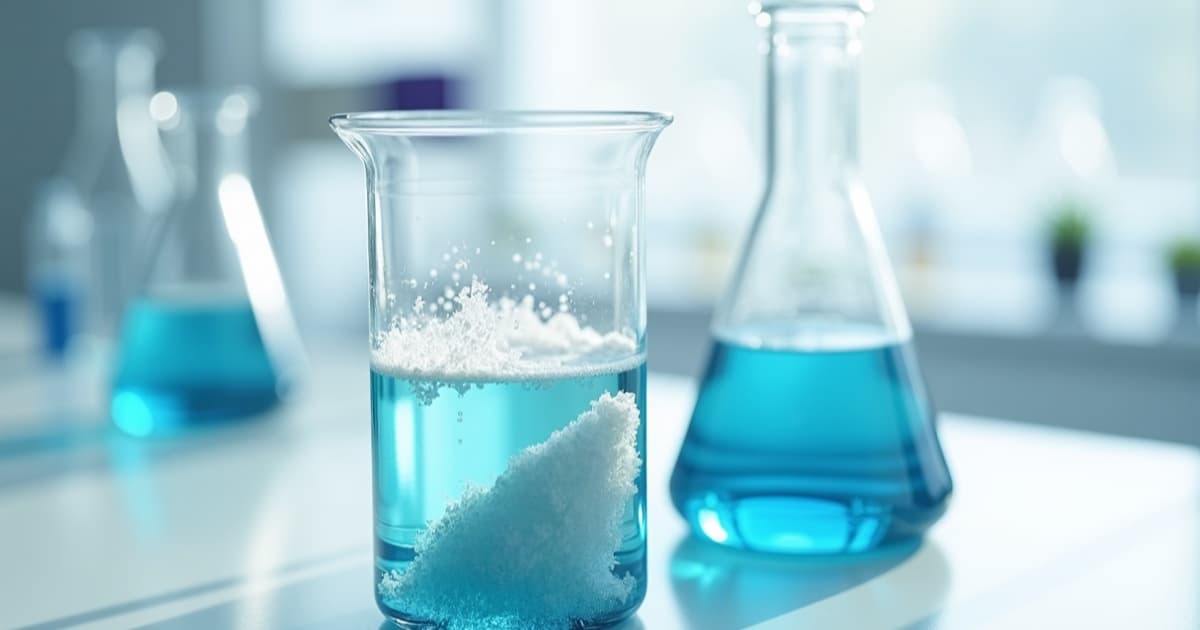
A standard pH probe needs several millilitres of sample, destroys what it measures, and leaks potassium chloride into it — none of which suits a 200 µL peptide stock. That is why pH frequently goes unmeasured in peptide work even when it matters, and why the usual answer is to control pH by construction rather than verify it afterwards.
Why the standard approach fails here
Three separate problems, and each would be enough on its own.
Volume. A conventional glass combination electrode needs enough liquid to submerge both the sensing bulb and the reference junction. For most benchtop probes that is a few millilitres. A peptide stock is frequently one or two hundred microlitres.
Contamination. The reference junction works by leaking electrolyte — usually saturated potassium chloride — into the sample. That is not a fault; it is how the measurement is made. But it means the sample now contains added salt, and in a small volume the addition is proportionally large.
Recovery. Anything the probe touches is contaminated and anything left on the probe is lost. For a precious stock, measuring pH conventionally means spending the sample to learn its pH.
| Method | Volume needed | Sample recoverable? | Typical resolution |
|---|---|---|---|
| Benchtop combination electrode | Millilitres | No | 0.01 pH units |
| Microelectrode / spear tip | Tens of microlitres | No | 0.01–0.1 |
| Indicator paper | A single drop | No, but the drop is small | 0.5–1 pH unit |
| Measuring a surrogate | None of the stock | Yes, entirely | As good as the surrogate |
What is the surrogate approach?
Prepare the diluent, measure its pH before the peptide is added, and treat that as the answer. It costs none of the sample and it is accurate whenever the peptide is a minor component by mass, which at typical working concentrations it usually is.
Where it breaks down is at high peptide concentration, or where the peptide carries a substantial counter-ion load. Trifluoroacetate is the conjugate base of a strong acid, so a peptide carrying a lot of it dissolved in unbuffered water produces a solution noticeably more acidic than the water was. The surrogate reading then describes the diluent rather than the solution.
When does a pH figure actually matter?
Less often than the effort to measure it would suggest, and in three identifiable situations.
Solubility is the first. A peptide near its isoelectric point carries no net charge and is least soluble there, so a solution that will not clear is often a pH problem rather than a concentration problem, and knowing the pH is the fastest route to the diagnosis.
Stability is the second. Hydrolysis and deamidation both have pH dependence, so a solution intended to last needs to sit away from the values that accelerate them.
Assay compatibility is the third, and it is the one where a surrogate measurement is entirely adequate — what matters is the pH of the final mixture, which is dominated by the assay buffer rather than by the small volume of stock added to it.
Options when the stock itself must be measured
Indicator paper on a single drop. Crude, cheap, and better than nothing. A half-unit resolution is enough to distinguish "roughly neutral" from "clearly acidic", which is usually the question being asked. The drop is sacrificed; the rest of the stock is untouched.
A microelectrode. Spear-tip and micro-combination probes work in tens of microlitres and give real resolution. They are fragile, they need careful calibration at the volumes involved, and they still leak electrolyte into whatever they touch — so the measured aliquot is spent.
A sacrificial dilution. Take a small aliquot, dilute it into a known volume of water, and measure that. The reading is not the stock's pH, but for a solution dominated by a strong acid counter-ion it tracks it usefully, and the stock is untouched beyond the aliquot.
Does the counter-ion really change the pH that much?
For a peptide rich in basic residues, yes. Counter-ion load scales with the number of arginines, lysines and histidines, and a trifluoroacetate salt of a basic peptide dissolved in pure water can give a distinctly acidic solution with nothing else added.
That is one reason an acetate-exchanged form behaves differently in the vial, quite apart from any assay interference. It is also why two peptides reconstituted identically in the same water can sit at different pH values, and why a surrogate reading taken on the water alone can mislead for one of them and not the other.
Which compounds make this worth the trouble?
Those where the chemistry is pH-dependent in a way that affects the result. A thiol compound is one — thiol oxidation rate depends on pH, and a solution sitting at the wrong value degrades faster than the same solution held correctly.
A metal-binding peptide is another, and more sharply: complex formation and stability are both pH-dependent, so the pH is not a handling detail but part of what defines the species present in the tube.
For a straightforwardly soluble, chemically unremarkable peptide dissolved in a standard reconstitution solution and used within its window, measuring pH is effort spent on a number that will not change a decision.
Controlling pH instead of measuring it
The more reliable strategy for small volumes is to remove the uncertainty rather than quantify it. If the diluent is buffered at a known pH and the peptide is a minor component, the solution's pH is known by construction and no measurement is needed.
That is the practical argument for choosing a buffer deliberately rather than defaulting to water: a buffered solution has a pH you decided, and an unbuffered one has a pH you would have to go and find out.
The trade is that a buffer adds species to the condition, which has to be matched in the vehicle control and may interfere with some assays. For many peptides, unbuffered water with a known counter-ion is the simpler system even though its pH is less certain.
How should pH be recorded when it was not measured?
Honestly, and specifically. "Reconstituted in unbuffered sterile water; pH not measured" is a useful line, because it tells a reader exactly what is and is not known. "pH 7" written without a measurement is worse than nothing, because it asserts a value nobody established.
Where the surrogate approach was used, say so: "diluent measured at pH 7.2 before addition" describes what was actually done. The distinction costs a few words and it is the difference between a reproducible condition and an assumed one.
Does temperature affect the reading?
Enough to matter at the resolution a microelectrode offers. pH is temperature-dependent, both because the electrode's response changes and because the buffer's own equilibrium shifts, so a reading taken on a cold sample and compared against a calibration done at room temperature carries an error.
For half-unit indicator paper this is noise. For a probe being read to two decimal places it is not, and letting the sample equilibrate to the calibration temperature is the simplest fix — the same discipline that applies to pipetting a cold solution with a room-temperature instrument.
Calibration at small volumes
A microelectrode is only as good as its calibration, and calibrating at small volumes introduces its own problems that are easy to skip past.
Standard buffers are supplied for ordinary probes and ordinary volumes. Using a few hundred microlitres of buffer in a small vessel means a large surface-to-volume ratio, and an exposed buffer absorbs carbon dioxide from the air, which lowers its pH over time. A calibration performed against a buffer that has been sitting open is calibrated against a value that is no longer its label value.
Two-point calibration bracketing the expected range is the minimum, and fresh buffer each time is the part most often skipped. Where readings are being taken to two decimal places, the calibration is more likely to be the limiting error than the probe.
How often does a microelectrode need recalibrating?
More often than a benchtop one, because the junction is smaller and clogs faster, and because small-volume work tends to involve higher protein and peptide concentrations than the probe was designed for. Material adsorbing to the junction shifts the reading slowly and without obvious symptoms.
The practical check is to re-read a standard buffer after a session. A reading that has drifted means the measurements taken since the last calibration carry that drift, and the extent of it is now known rather than suspected.
Is a colour-based reading ever good enough?
For the questions most peptide work actually asks, usually yes. "Is this solution roughly neutral or clearly acidic" is answerable with indicator paper to half a unit, and that resolution is sufficient to diagnose a counter-ion effect or confirm a buffer was made correctly.
Where it is not sufficient is anywhere the pH is a controlled variable rather than a sanity check — a stability study, or work where solubility depends on sitting a defined distance from the isoelectric point. There the measurement has to be real, and the sample cost has to be accepted.
Does the counter-ion explain a solution that will not behave?
Often, and it is worth checking before anything more elaborate. A basic peptide as its trifluoroacetate salt dissolved in unbuffered water gives an acidic solution, and if the work assumed neutrality the discrepancy propagates into solubility, stability and any pH-sensitive readout.
A single indicator-paper reading on one drop settles it in seconds. Where the answer is "clearly acidic" and neutrality was assumed, the salt form is the first thing to check on the certificate, and an acetate-exchanged lot may be the simpler fix than buffering around the problem.
All products referenced here are supplied for laboratory and research use only. They are not drugs, foods, supplements or cosmetics, and are not for human or veterinary use.