NAD+ is not a peptide, and it is worth being explicit about that before anything else. It is a dinucleotide coenzyme — two nucleotides joined through their phosphates — and it sits in a research peptide catalogue because the questions it is studied alongside overlap, not because it belongs to the same chemical class. Its handling requirements are correspondingly different, and the assumptions that carry over from a lyophilised peptide mostly do not.
What the molecule does
NAD+ is an electron carrier — as is glutathione, by a different chemistry, and the two are often studied together. It cycles between an oxidised form (NAD+) and a reduced form (NADH), accepting a hydride at the nicotinamide ring and releasing it elsewhere. Essentially every catabolic pathway in a cell deposits electrons onto it, and oxidative phosphorylation collects them. On that account alone it would be a housekeeping molecule rather than a research target.
The reason it became interesting is the second job. A family of enzymes consumes NAD+ rather than cycling it — sirtuins, which remove acetyl groups from proteins, and PARPs, which respond to DNA damage. Both cleave NAD+ and release nicotinamide in the process. That makes NAD+ a consumable substrate whose availability can limit those enzymes, rather than simply a carrier that returns to its starting state.
Why is NAD+ described as a substrate and a coenzyme?
Because it genuinely serves both roles, and they behave differently. In redox chemistry it is a coenzyme: it is reduced and later re-oxidised, and the pool is conserved. In sirtuin and PARP reactions it is a substrate: the molecule is cleaved and must be resynthesised. Only the second role creates a demand that can deplete a pool, which is the whole basis for interest in the salvage pathway. Reading a paper without noticing which role is in play makes its conclusions difficult to interpret.
What is the salvage pathway?
The route that recycles nicotinamide — the fragment released when NAD+ is cleaved — back into NAD+. It runs through nicotinamide mononucleotide as an intermediate, and it is the dominant source of NAD+ in most tissues, well ahead of synthesis from tryptophan. The rate-limiting enzyme, NAMPT, is consequently a target of interest in its own right. The practical significance is that NAD+ concentration is the result of a flux, not a store: it reflects the balance between consumption and resynthesis, which is why a static measurement of concentration says less than it appears to.
The precursor question
Whether an intact NAD+ molecule crosses a cell membrane is contested, and the disagreement is the reason precursors are studied at all.
| Molecule | Size | Entry route | Steps to NAD+ |
|---|---|---|---|
| NAD+ | Large, doubly charged | Disputed; extracellular degradation likely | None |
| NMN | Smaller, charged | Transporter proposed; also dephosphorylation first | One |
| NR | Smallest, uncharged | Nucleoside transporters | Two |
| Nicotinamide | Very small | Diffusion | Two, via NAMPT |
The pattern is consistent: the further down the table, the easier the entry and the more enzymatic steps required afterwards. Extracellular enzymes also break NAD+ down into smaller fragments, so an experiment supplying NAD+ to cells may effectively be supplying its degradation products — which is exactly the confound that makes precursor comparisons hard to interpret.
Does supplying NAD+ to a culture raise intracellular NAD+?
Possibly, and not necessarily by the route assumed. If extracellular enzymes degrade it to nicotinamide riboside or nicotinamide, and those enter and are converted through the salvage pathway, intracellular NAD+ rises — but the molecule that crossed the membrane was not NAD+. Distinguishing the two requires either an inhibitor of the extracellular enzymes or isotope labelling. Without one of those, an experiment reports that intracellular NAD+ increased and cannot say why, which is a weaker result than it usually reads as.
Handling, which is where it differs most from a peptide
NAD+ is less forgiving than a lyophilised peptide, and in different ways.
It is unstable in alkaline solution. Above roughly pH 8 the oxidised form degrades measurably, and the reduced form has the opposite preference — NADH is the one that fails under acid. A buffer chosen without regard to which form is in play can degrade the material before the experiment starts.
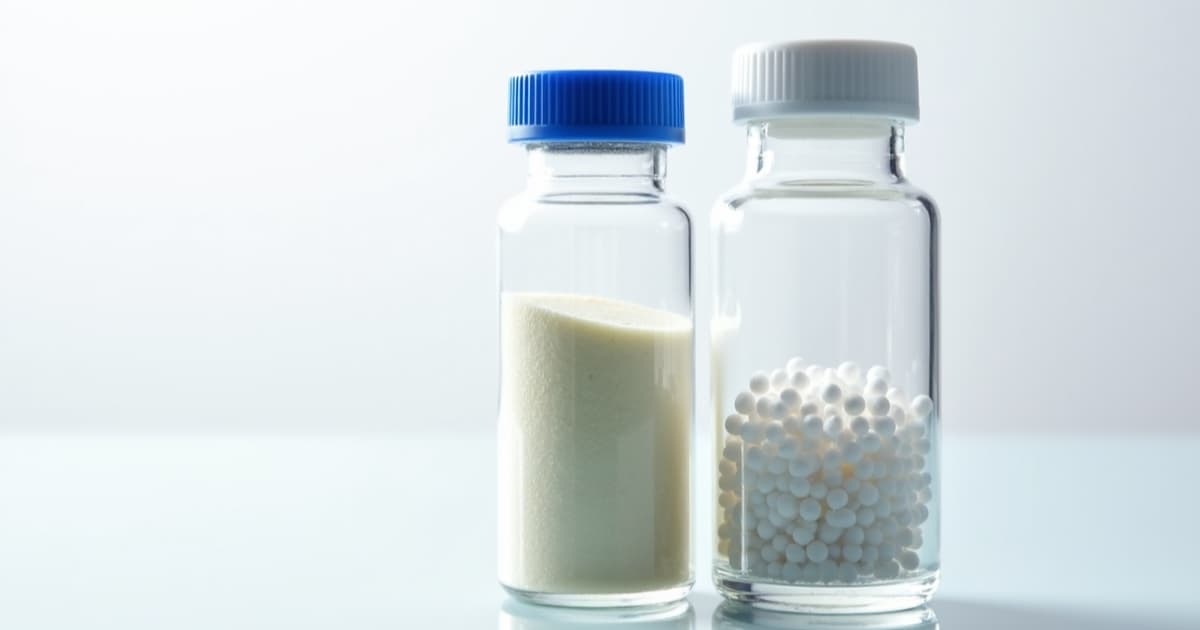
It is hygroscopic. The solid draws water readily. A vial opened cold, before it has reached room temperature, condenses moisture into the powder. Equilibrating a sealed vial to room temperature before opening is the whole of the fix, and it matters more here than for most peptides.
Solutions are for use, not for storage. Aqueous NAD+ degrades over days even refrigerated. Where a reconstituted peptide might be treated as usable for weeks, an NAD+ solution should be made close to when it is needed, and aliquoted rather than repeatedly thawed.
Can NAD+ be handled like a lyophilised peptide?
Not safely. Three assumptions that hold for peptides fail here: that a neutral buffer is a safe default, that a reconstituted vial keeps for weeks refrigerated, and that a cold vial can be opened immediately. NAD+ is pH-sensitive in a direction that depends on its oxidation state, degrades in solution over days rather than weeks, and takes up atmospheric water while cold. Anyone moving from a peptide catalogue to NAD+ is carrying assumptions that need setting aside.
Does the certificate for NAD+ look different?
Yes, because the analytical questions are different. There is no sequence to confirm and no net peptide content to report. Purity is still chromatographic, but the meaningful additional figure is the proportion in the oxidised form — a batch carrying a significant NADH fraction is a different material from one that is essentially all NAD+, and the distinction will not show up in a purity figure that treats both as the target. Knowing which question a panel answers is the general skill; it applies here with a different set of panels.
Why does NAD+ appear in a peptide catalogue at all?
Because catalogues are organised by what researchers study together rather than by chemical class. NAD+ sits alongside mitochondrial peptides and the bioregulator group because the research questions overlap, not because the chemistry does. The grouping is a convenience, and treating it as a statement about the molecule's properties is how the handling mistakes above get made.
All products referenced here are supplied for laboratory and research use only. They are not drugs, foods, supplements or cosmetics, and are not for human or veterinary use.