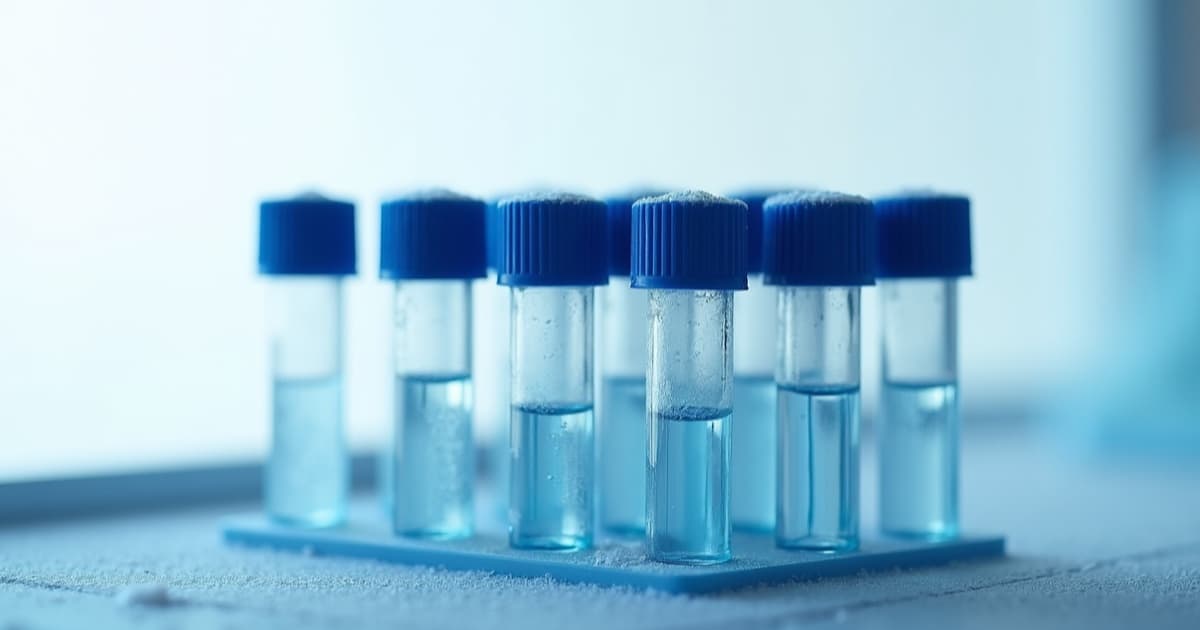
Aliquot at reconstitution, before the first freeze. That single decision removes the most avoidable degradation route in peptide work, and it costs about four minutes and a rack of tubes.
The damage is not from being cold. A peptide held steadily at −20 °C or −80 °C is in about the most stable state available to it. The damage comes from the transition, repeated.
What a freeze–thaw cycle does
Four things happen on the way through, and none of them are gentle:
- Ice crystals form and grow. Water crystallises first, leaving the peptide concentrated in a shrinking volume of unfrozen liquid, pressed against an expanding ice surface.
- Solutes concentrate sharply. Buffer salts left behind in that shrinking volume can reach many times their nominal concentration, taking local pH with them — a phosphate buffer can shift substantially as one component crystallises before the other.
- New interfaces appear. Every ice–liquid boundary is a surface, and peptides adsorb to and unfold at surfaces. Unfolded molecules find each other.
- It reverses on thaw. The same gradients run backwards, and aggregates formed on the way down do not necessarily redissolve on the way up.
The loss per cycle is usually small. It is the repetition that matters: a stock opened twelve times over three months has been through twelve of these, and the aggregate is no longer small.
Why aliquoting solves it completely
A single-use aliquot is thawed once and discarded. The cycle count per tube is one, permanently, regardless of how long the work runs or how many times you return to it. No handling discipline achieves this — only the geometry of the storage does.
| Approach | Cycles per tube over 20 uses | Cost |
|---|---|---|
| One stock vial, opened each time | 20 | Free, then expensive |
| Four working aliquots | 5 | 4 tubes |
| Twenty single-use aliquots | 1 | 20 tubes |
How small should an aliquot be?
One experiment's worth, plus a margin for the volume you will lose to the tube wall and the pipette tip. Smaller is not automatically better — very small volumes have a high surface-to-volume ratio, which makes adsorption losses proportionally worse and makes accurate recovery harder. Something in the 50–200 µL range suits most bench work; the right answer is whatever one run consumes.
Does the tube material matter?
More than people expect, and it is the companion problem to this one. Peptides adsorb to polypropylene, and at low concentration the fraction lost to the wall stops being trivial. Adsorption at low concentration covers what to do about it — in short, low-binding tubes and a carrier protein where the assay tolerates one.
Is −80 °C meaningfully better than −20 °C?
For long storage, yes — molecular motion is lower and the remaining unfrozen water fraction is smaller. For short storage of a well-behaved peptide, −20 °C is generally adequate and the difference is modest. The more consequential variable is not which freezer but how many times the tube enters and leaves it. A single-use aliquot at −20 °C outlasts a repeatedly opened stock at −80 °C.
What about frost-free freezers?
Avoid them for anything that matters. Automatic defrost works by cycling the temperature up periodically to melt accumulated ice — which means the freezer is deliberately putting your samples through partial thaw cycles on a schedule, invisibly. A manual-defrost unit is the correct choice, and it is a common and expensive oversight.
Thawing, briefly
Thaw on ice or at 4 °C rather than at room temperature or in the hand. The goal is to move through the transition slowly and to avoid any part of the solution sitting warm while the rest is still frozen. Once thawed, mix by gentle inversion — never vortex, which drives exactly the air–liquid interface exposure that unfolds peptides.
And label the tube with the compound, the lot, the concentration and the date. A freezer box of unlabelled aliquots is a box of material nobody will trust in six months, which is a more complete loss than any number of freeze–thaw cycles.
Lyophilized powder is a different question
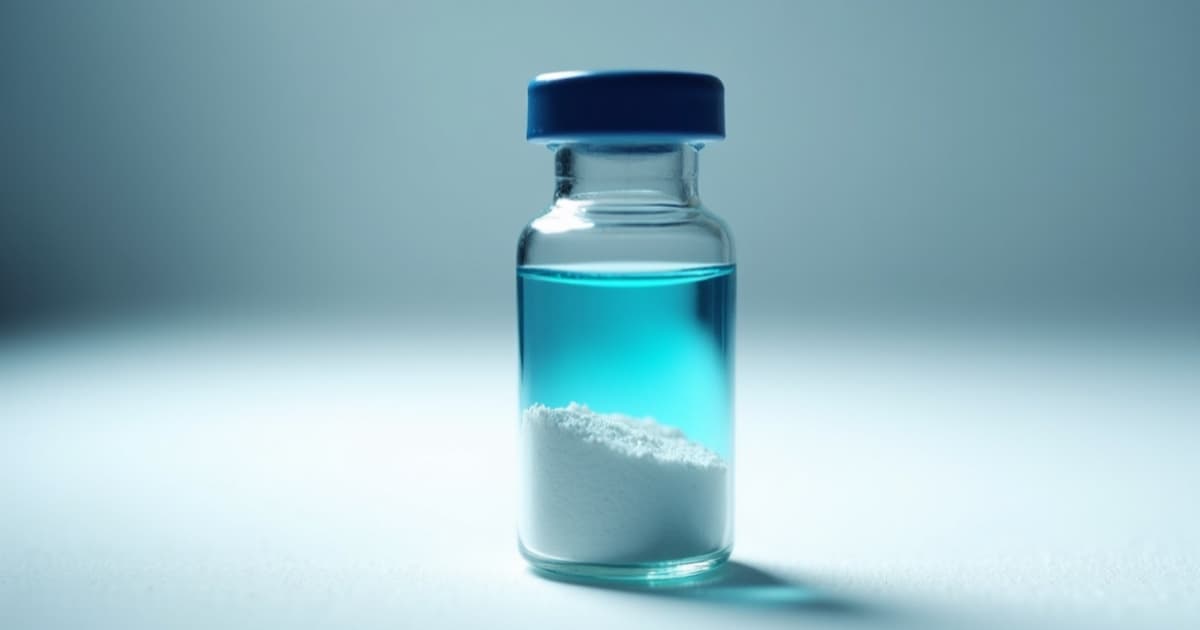
Everything above concerns solutions. An unopened lyophilized vial is far more robust, because the degradation routes that matter in solution — hydrolysis, deamidation, disulphide scrambling — all need water to proceed, and a properly freeze-dried cake has very little.
Two things still reach it. Moisture, because lyophilized solids are hygroscopic and a vial brought from the freezer to a warm bench will condense water on and in the cake if opened before it reaches room temperature. Let a vial equilibrate sealed, every time; it costs fifteen minutes and prevents a problem that cannot be reversed. And light, for sequences containing tryptophan, tyrosine or cysteine, which is why amber vials and closed boxes are standard rather than decorative.
Does the cake appearance tell you anything?
Some. A good cake is uniform and holds its shape. A cake that has collapsed into a glassy film, shrunk away from the wall, or turned from white to off-white has been through something — usually a temperature excursion during shipping or storage — and while the material may still be within specification, it is a reason to check the certificate date and consider verifying before committing it to a long experiment. What the certificate reports is the reference point for that judgement.
All products referenced here are supplied for laboratory and research use only. They are not drugs, foods, supplements or cosmetics, and are not for human or veterinary use.