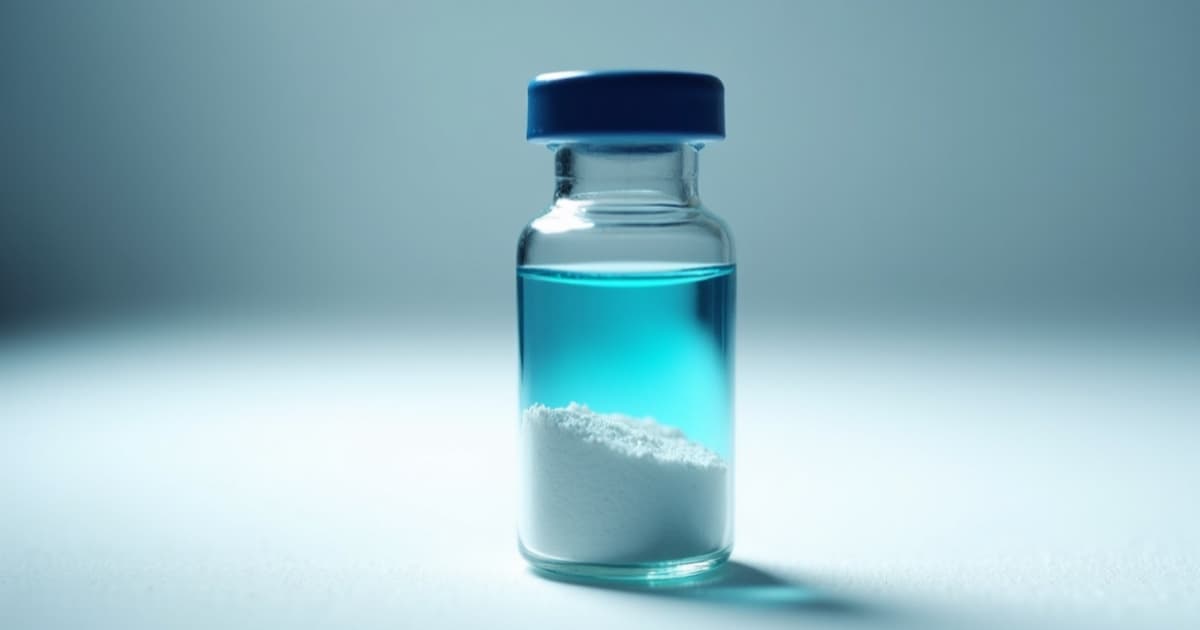
Concentration is mass divided by volume. That is the whole of it. A 5 mg vial reconstituted with 2 mL of diluent gives 2.5 mg/mL, and a 5 mg vial reconstituted with 5 mL gives 1 mg/mL. Every reconstitution mistake is a failure to control one of those two terms — and the mass term goes wrong more often than the volume term, for reasons that have nothing to do with arithmetic.
The equation, and the only rearrangement worth memorising
Three quantities, any two of which give you the third:
- C = m / V — concentration from the mass in the vial and the volume added
- V = m / C — the volume to add to reach a concentration you have chosen
- m = C × V — the mass present in a volume you have drawn
The second one is the one you actually use. You rarely start by asking "what concentration will this give me"; you start with a working concentration the protocol requires and work backwards to the volume. Our reconstitution calculator does this arithmetic, but the arithmetic was never the hard part.
What that looks like across real vial sizes
| Vial | Diluent added | Resulting concentration | Mass in a 0.1 mL aliquot |
|---|---|---|---|
| 5 mg | 1 mL | 5 mg/mL | 0.5 mg |
| 5 mg | 2 mL | 2.5 mg/mL | 0.25 mg |
| 5 mg | 5 mL | 1 mg/mL | 0.1 mg |
| 10 mg | 2 mL | 5 mg/mL | 0.5 mg |
| 10 mg | 5 mL | 2 mg/mL | 0.2 mg |
| 50 mg | 5 mL | 10 mg/mL | 1 mg |
Notice that the 5 mg/1 mL and 10 mg/2 mL rows give the same concentration from different vials. Concentration does not remember where it came from — which is exactly why recording the vial size alongside the concentration matters when the work is written up.
Where the number actually goes wrong
Why is the mass on the label not the mass in the vial?
A lyophilized vial labelled 5 mg contains 5 mg of material, and that material is peptide plus counter-ion plus residual water. Net peptide content — the fraction that is actually peptide — is commonly in the 70–90% range for a trifluoroacetate salt, and it is reported on the certificate rather than the label. Reconstituting a 5 mg vial to "5 mg/mL" therefore produces something closer to 4 mg/mL of peptide. What a 5 mg vial actually contains takes this apart properly. The choice of diluent does not change the arithmetic, though it does change how long the number stays meaningful. A calculator does the division, with the inputs it is given.
Does the powder add volume?
Slightly, and it is usually ignored. Adding 2 mL of diluent to 5 mg of solid gives a final volume marginally above 2 mL, because the solid occupies space once dissolved. At milligram scale the error is well under a percent and smaller than the pipetting error beside it. At 50 mg or 100 mg in a small volume it stops being negligible, and the honest move is to reconstitute to a final volume in a volumetric vessel rather than adding a measured volume to the vial.
How accurate is the diluent volume itself?
More variable than most people assume. A 1 mL graduation on a disposable syringe is not a calibrated volumetric measurement, and reading to the meniscus by eye across a curved barrel carries a few percent easily. If the concentration matters to better than about 5%, the diluent goes in by calibrated pipette, not by syringe graduation.
Does it matter how fast the diluent goes in?
Yes, though not to the concentration — to whether the peptide survives. Diluent directed straight onto the lyophilized cake, or a vial shaken to speed dissolution, drives shear and air–liquid interface exposure, both of which promote aggregation. Diluent run down the inside wall, then left to dissolve with gentle swirling, gets the same concentration with less damage. The arithmetic is indifferent; the peptide is not.
Serial dilution, and the error that compounds
Working concentrations are usually reached by diluting a stock rather than by reconstituting to the target directly, because a 1 mg/mL stock is easier to handle accurately than a 10 µg/mL one. The trade is that errors multiply rather than add: three sequential 1:10 steps each carrying 3% error give a final concentration that can sit about 9% away from nominal, in whichever direction the errors happen to align.
Two practical consequences. Use the fewest steps that reach the target, and make each step as large as accuracy allows — one 1:100 dilution done with a calibrated pipette beats two 1:10 steps done casually. And where the final number matters, verify rather than assume.
Should the stock be made at the highest concentration possible?
Not always. A concentrated stock is more stable per unit volume and wastes less vial, but solubility sets a ceiling and aggregation risk rises as you approach it. It also makes every downstream dilution larger and therefore more error-prone. A stock at roughly ten to a hundred times the working concentration is the usual compromise.
Recording it so the experiment can be repeated
A concentration on its own is not a record. What makes the work reproducible is the set: the compound and lot, the mass stated on the vial, the net peptide content from the certificate, the diluent and its composition, the volume added, the resulting nominal concentration, and the storage condition afterwards. Six lines, and without them the same vial reconstituted next month is a different experiment.
Every lot in this catalog has a certificate carrying the content figure those six lines depend on — you can look one up by lot number on the COA verification page.
All products referenced here are supplied for laboratory and research use only. They are not drugs, foods, supplements or cosmetics, and are not for human or veterinary use.