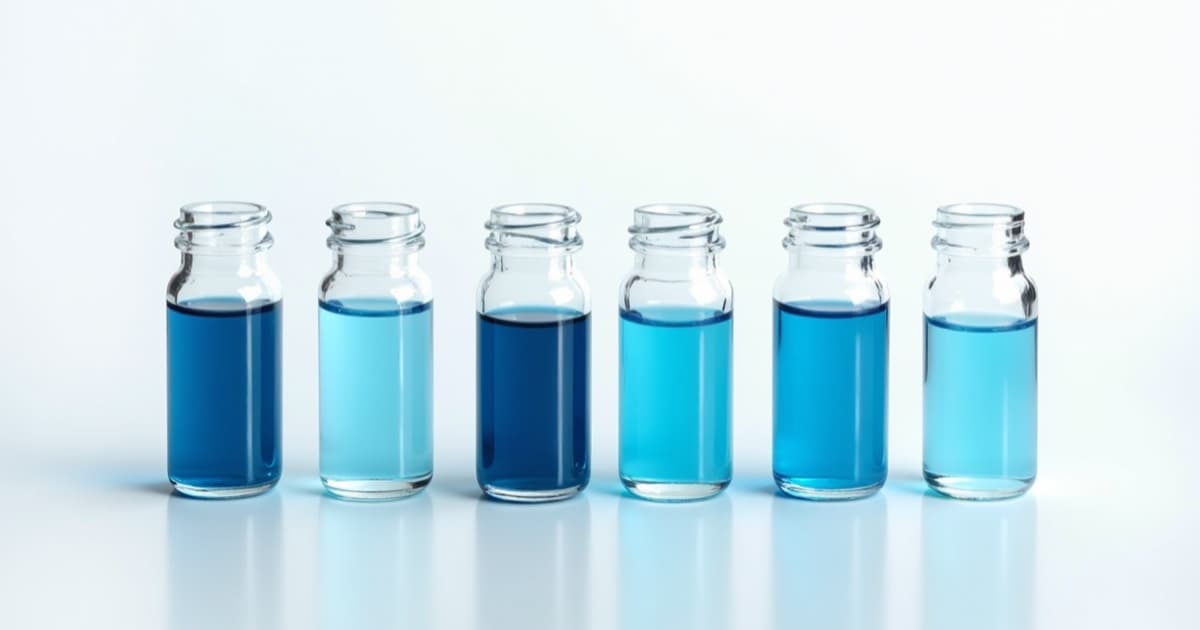

A serial dilution multiplies its errors, and by the sixth step a two-percent slip has become a ten-percent one. The arithmetic is simple and the technique is routine, which is exactly why the errors get in: nobody thinks of a dilution series as an experiment in its own right. It is, and the choices made while building it — step size, tube, mixing, whether each point comes from the stock or from its neighbour — decide how much the final concentrations can be trusted.
Two ways to build a series
A chained series makes each dilution from the previous one: stock to A, A to B, B to C. It needs the least material and the fewest pipette settings, and every error it makes is passed down the line. An independent series makes each point directly from the stock at a different ratio. It uses more stock, needs more careful volume choices, and its errors stay where they happen.
| Chained | Independent | |
|---|---|---|
| Material used | Least | More |
| Error at step n | Accumulates with each step | Only that step's error |
| Suits | Screening, wide ranges | Anything an EC50 will be reported from |
| Failure mode | One bad step ruins everything below it | One bad point, easily spotted |
How much does the error actually compound?
Roughly with the square root of the number of steps, if each step's error is independent and random. Six chained steps each accurate to two percent give a final point accurate to about five; if one step carries a systematic error — a mis-set pipette, a tip that did not fully deliver — it is inherited by every point below it and does not average out. That is the case to fear. A dilution series that looks smooth and is uniformly wrong from step three onward produces a clean curve with the wrong EC50, and nothing on the plate reveals it. The design of the experiment is only as good as the series behind it.
Why half-log steps rather than tenfold?
Because tenfold steps are too coarse for a curve and half-log steps are the practical compromise. A 1:3.16 dilution places three points per decade of concentration, which is enough to define the slope of a sigmoid. Tenfold steps put one point per decade and leave the informative region between two of them. The arithmetic is slightly less tidy — 1 part into 2.16 parts — and worth doing anyway. A series of 1:3 is close enough for most purposes and easier to pipette.
Where peptides make it harder
Three things that do not trouble a small-molecule series.
Adsorption at the dilute end. Each tube in the chain takes a fixed amount of peptide onto its wall, and at the low end that amount is a large fraction of what is present. The last three or four points of a chained series can be substantially below their nominal concentration for this reason alone. Low-binding tubes and a carrier protein are the answer, and pre-wetting each tip in the solution it will transfer is the free version.
The stock concentration is uncertain to begin with. A stock calculated from label mass overstates the peptide by whatever the net content falls short of, and the whole series inherits that. Correct at the stock, from the certificate's content figure, before the first dilution.
Time. A series that sits for an hour before use is a series whose dilute points have been adsorbing and, for an unmodified peptide in medium, degrading. Make it last, use it first.
Should dilutions be made in buffer or in medium?
In whatever the compound will finally be in, for the last steps at least. Diluting in water or plain buffer and then adding to serum-containing medium changes the peptide's environment at the final step — albumin binding, protease exposure, ionic strength — in a way the intermediate points did not experience. For anything acylated, the difference between a buffer dilution and a medium dilution is the difference between free and albumin-bound compound. Where the medium is expensive, a common compromise is buffer for the early steps and medium for the last two.
How should mixing be done between steps?
Gently and completely, which pull in opposite directions. Incomplete mixing is the commonest hidden error: a transfer taken from the top of a tube where the added stock has not yet distributed carries the wrong concentration, and the error is random rather than systematic, which makes it invisible in a curve fit and visible only as noise. Vortexing fixes mixing and introduces foaming, and foaming denatures peptides at the air–liquid interface. Inversion five or six times, or pipetting up and down without drawing air, does the job without the interface damage.
What should be written down?
The stock's identity and true concentration; the diluent for each step; the volumes, not just the ratios; the tube type; and the time the series was made relative to when it was used. A series recorded as "1:3 serial in PBS" cannot be repeated exactly, because it does not say from what, in what tubes, or how long before use. The calculator gives the numbers; the record is what makes them reproducible.
Can a serial dilution be stored?
The concentrated end, yes; the dilute end, no. Points above about 10 µg/mL behave like small stocks and can be frozen in single-use aliquots. Below that, adsorption and degradation act on a quantity too small to spare any, and a stored dilute point is a point of unknown concentration by the time it is used. The practical rule is to freeze the top two or three and remake everything below them fresh on the day.
All products referenced here are supplied for laboratory and research use only. They are not drugs, foods, supplements or cosmetics, and are not for human or veterinary use.