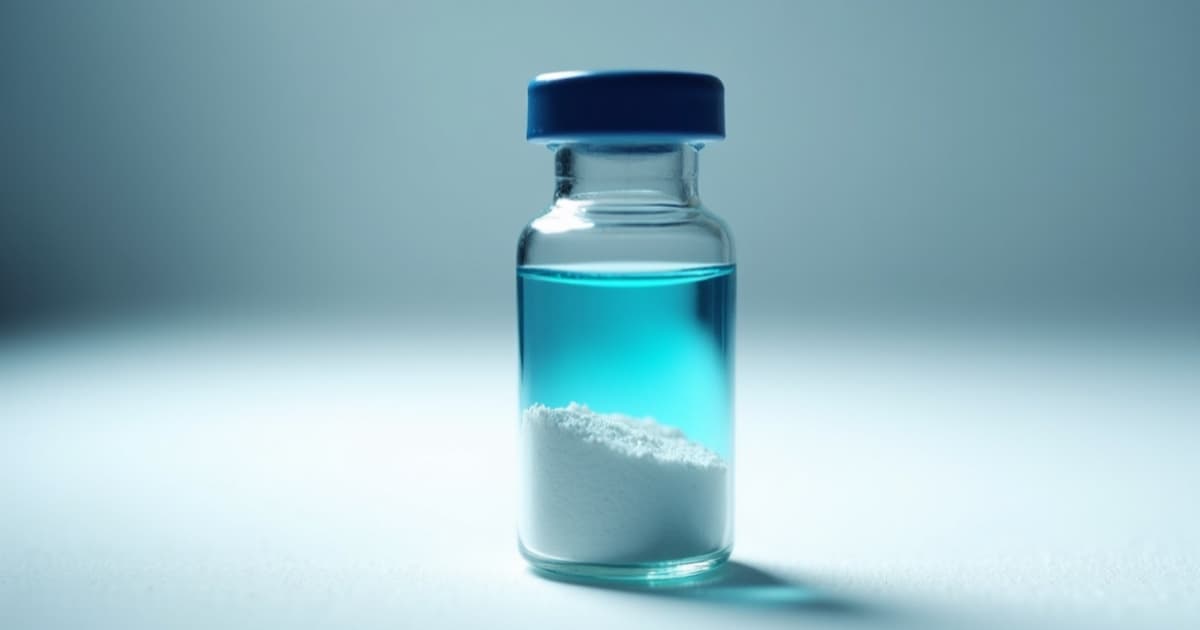
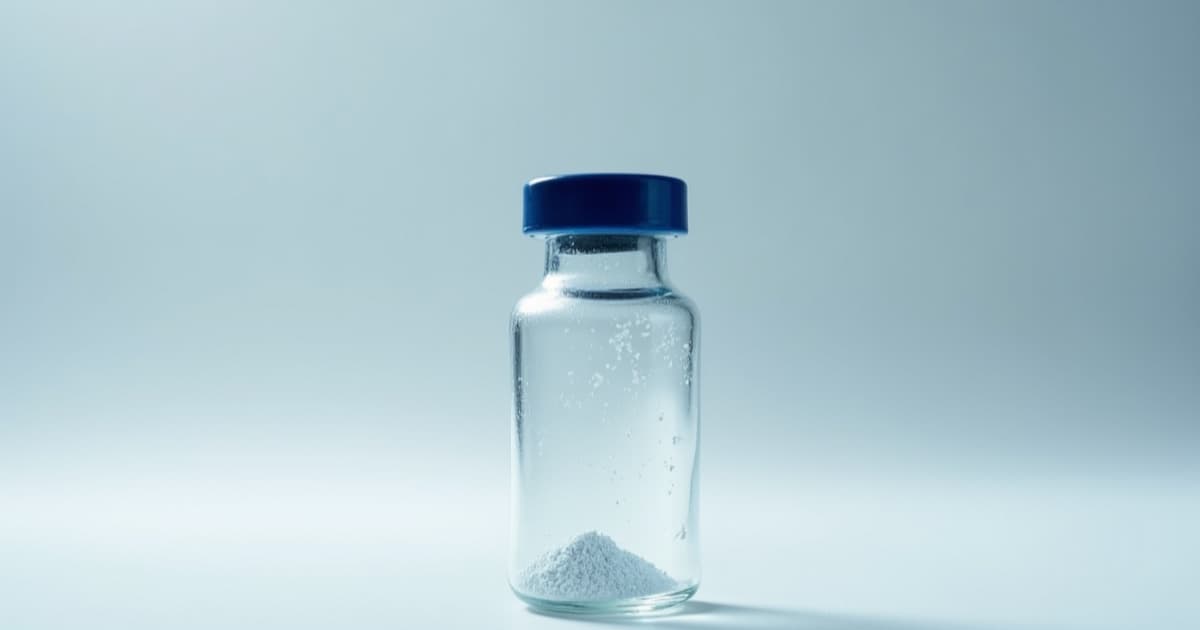
A vial that looks empty almost always is not. Five milligrams of lyophilised peptide occupies a volume most people would not notice at the bottom of a glass vial, and the freeze-drying process routinely leaves it as a thin film on the wall rather than a visible cake at the base. The vial being sold as 5 mg and appearing to hold nothing are entirely compatible observations.
How little 5 mg actually is
A lyophilised peptide cake is mostly air. The process freezes a solution and then sublimes the ice away under vacuum, leaving the solute occupying roughly the space the ice did — a porous, low-density structure. Bulk density for such a cake is often in the region of 0.1–0.3 g/cm³, so 5 mg occupies something like 20–50 microlitres of apparent volume.
In a 2 mL vial, that is a layer well under a millimetre deep, and it is white against clear glass. Tilting the vial under a light is usually enough to see it. Looking straight down through the stopper usually is not.
Where does the powder go if it is not at the bottom?
Onto the walls, most often, and it gets there during shipping rather than during manufacture. A cake is fragile; vibration over a few days breaks it up and static distributes the fragments around the interior. It is also possible for the cake to have formed part-way up the wall if the solution crept before freezing. Neither is a defect and neither means material has been lost — the peptide is in the sealed vial, wherever in it that happens to be. A brief centrifugation, or a firm tap on the bench, brings it down before the vial is opened.
Should a vial be centrifuged before opening?
It is worth doing and costs nothing. A few seconds in a benchtop centrifuge collects material off the walls and the stopper at the base, so none is lost to the stopper when the vial is opened and none is left stranded above the eventual liquid level. If no centrifuge is available, tapping the vial base firmly against the bench achieves most of it. The step matters more for small masses, because a fixed amount clinging to a stopper is a larger proportion of 5 mg than of 50 mg.
What the cake tells you
Appearance carries some information, though less than it is often credited with.
| Appearance | Reading |
|---|---|
| White porous cake at the base | Normal |
| Thin film on the wall, or scattered flakes | Normal; shipping broke the cake up |
| Nothing visible at first glance | Usually normal; tilt it under a light |
| Shrunken, glassy or collapsed | Went above its collapse temperature |
| Liquid, oily or sticky | Real problem — moisture or heat |
What does a collapsed cake mean?
That the material warmed past the temperature at which its frozen structure holds shape, either during lyophilisation or afterwards. The porous cake melts into a denser glassy layer. It is not automatically degraded peptide — collapse is a physical change — but it indicates a temperature excursion, and it often comes with higher residual moisture because the collapsed structure traps water the drying step could not reach. More moisture means faster degradation in storage. A collapsed cake is a reason to ask about handling history, not a reason to assume the contents are ruined.
Is a sticky or liquid appearance the same problem?
Worse, and different. A cake that has gone gummy or partly liquid has taken up substantial water, either from a compromised seal or from being opened while cold. Lyophilised peptide is hygroscopic, and once water is present the degradation routes that lyophilisation existed to prevent are running again. This is the one appearance on the list that genuinely warrants setting the vial aside and contacting the supplier with the lot number. It is also the one most often caused after delivery rather than before — letting a sealed vial reach room temperature before opening it prevents most of it.
What is actually in the vial
Less peptide than the label mass, always. The powder includes the counter-ion paired to every basic site, bound and residual water, and a small fraction of peptide-related impurities. A 5 mg vial commonly holds something closer to 3.5–4.2 mg of peptide, and the figure that resolves it is net peptide content on the certificate rather than anything visible.
This is worth separating from the appearance question because they get conflated. A vial looking empty is an optical matter. A vial containing less peptide than its label says is an accounting matter, it is expected rather than exceptional, and it is the one that changes your arithmetic.
Can I confirm the vial is not empty without opening it?
Not by weighing it, which is the usual instinct. A few milligrams is within the variation of the glass, the stopper and the crimp between one vial and another, so a balance cannot separate a full vial from an empty one at this scale. What works is visual: tilt the vial and rotate it slowly against a dark background under good light, and the film or flakes become obvious. If the concern is real, the supplier's lot record is the better route — fill weight is part of the batch documentation, and the certificate is tied to the lot number on the label.
Does the vial size change how much peptide I get?
No. A 5 mg fill in a 2 mL vial and the same fill in a 10 mL vial contain the same peptide; the larger vial simply looks emptier. Vial size is chosen for the reconstitution volume the material is expected to take and for handling convenience, not as a proxy for contents. Judging quantity by how full the vial looks is the reasoning this whole question comes from, and it does not work at these masses.
All products referenced here are supplied for laboratory and research use only. They are not drugs, foods, supplements or cosmetics, and are not for human or veterinary use.