A preservative in the diluent buys tolerance for repeated entry; it does not buy tolerance for careless entry. Bacteriostatic water holds back organisms introduced despite good technique. It cannot rescue a vial that was contaminated by bad technique, and it does nothing at all against the chemistry that entry introduces — oxygen, moisture, and whatever was on the stopper. The technique is what keeps a multi-entry vial usable for the weeks the preservative promises, and most of it is about the stopper.
What an entry actually introduces
| Introduced by | What it brings | What stops it |
|---|---|---|
| The stopper surface | Organisms, dust, residue from the last entry | A wiped, dried stopper |
| The instrument | Organisms, residue from other solutions | A sterile, single-use instrument |
| Air drawn in as volume is removed | Oxygen, moisture, airborne particles | Nothing fully; minimise entries |
| The hands | Organisms on the vial neck and cap | Not touching the stopper |
The preservative addresses the first column's organisms and only those. Everything else in the table is either mechanical or chemical, and it accumulates with every puncture.
Why does the stopper need to dry before entry?
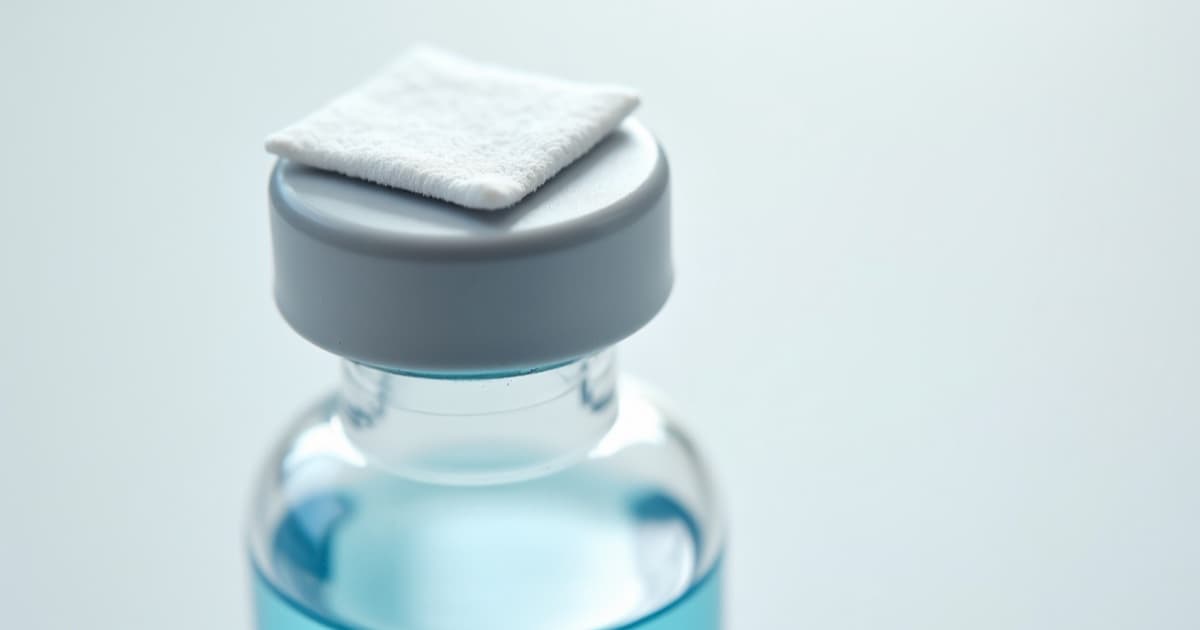
Because the alcohol does the work while it evaporates, not while it is wet. Seventy percent isopropanol kills by denaturing proteins as it dries on a surface, and the contact time — the fifteen to thirty seconds it takes to evaporate — is when that happens. Entering a stopper that is still wet does two things wrong at once: it cuts the contact time short, and it carries a droplet of alcohol into the vial on the instrument. A small amount of isopropanol in a peptide solution is not catastrophic, but it is an uncontrolled additive, and for a compound near its solubility limit it can be enough to start precipitation. Wipe, wait, then enter.
Is one wipe enough?
One wipe with a fresh pad, in one direction, is the standard, and the detail that matters is "fresh". A pad reused from the previous vial carries that vial's stopper onto this one. A wipe that scrubs back and forth redistributes rather than removes. Individually sealed pads exist so that each wipe starts clean, and the cost of using two on one stopper is trivial against the cost of a contaminated vial.
The part the preservative cannot help with
Every entry lets air into the headspace to replace the volume removed. That air carries oxygen, which oxidises methionine, cysteine and tryptophan over time, and moisture, which is absorbed into whatever solution is present. A vial entered twenty times has exchanged a meaningful fraction of its headspace twenty times. For a stable sequence this is a slow effect. For an oxidation-prone one it is the reason a multi-entry vial degrades faster than the same solution held in single-use aliquots — the case for aliquoting is partly a case for never entering the stock at all.
How many entries is too many?
There is no fixed number, and the useful question is different: how many entries does the work actually need? A stock that will be drawn from forty times is a stock that should have been aliquoted into forty tubes at reconstitution. A stock drawn from three or four times across a week is a reasonable multi-entry vial. The preservative's 28-day convention assumes ordinary use, and ordinary use means a handful of entries, not dozens. Beyond that, the stopper itself begins to fail — repeated punctures core the rubber and shed fragments into the solution.
Does the vial need to be at room temperature?
For entry, ideally yes, and for a reason beyond comfort. A cold vial drawn from a refrigerator condenses moisture on its stopper and its outer surface, and a wipe on a wet stopper is a wipe on a film of water rather than on rubber. The alcohol dilutes into it and the contact time is lost. Let the vial warm enough that the stopper is dry to the touch, wipe, wait, enter, and return it to cold. This is a smaller version of the rule for opening a lyophilised vial, and it fails for the same reason.
What the diluent choice changes
All of the above applies whichever diluent is in the vial. What the diluent changes is the consequence of a lapse. Bacteriostatic water gives a margin: an organism introduced despite good technique is held back rather than allowed to grow. Sterile water gives none, and a vial of it should be treated as single-entry, or as multi-entry only across a single session.
What does a contaminated vial look like?
Usually like a clean one, which is the problem. Bacterial growth sufficient to cloud a solution takes days at refrigerated temperature and is often preceded by nothing visible. Haze, a film, a change in colour or a smell on opening are late signs, and by then the solution has hosted growth for some time — along with whatever the organisms secreted, including the peptidases that remove a peptide from solution as effectively as any cell line. A vial that shows any of these is discarded, not filtered. Filtering removes the organisms and leaves everything they did.
What should be recorded for a multi-entry vial?
The date of first entry, and every entry after it — a tally on the label costs nothing. The preservative's window runs from first puncture, not from reconstitution, and the two are not always the same day. A vial marked with its reconstitution date, concentration, first-entry date and a tally of entries can be judged at a glance; one marked only with the compound name has to be assumed compromised past a certain age. The label is where the record lives, because it is the only record that stays with the vial.
All products referenced here are supplied for laboratory and research use only. They are not drugs, foods, supplements or cosmetics, and are not for human or veterinary use.