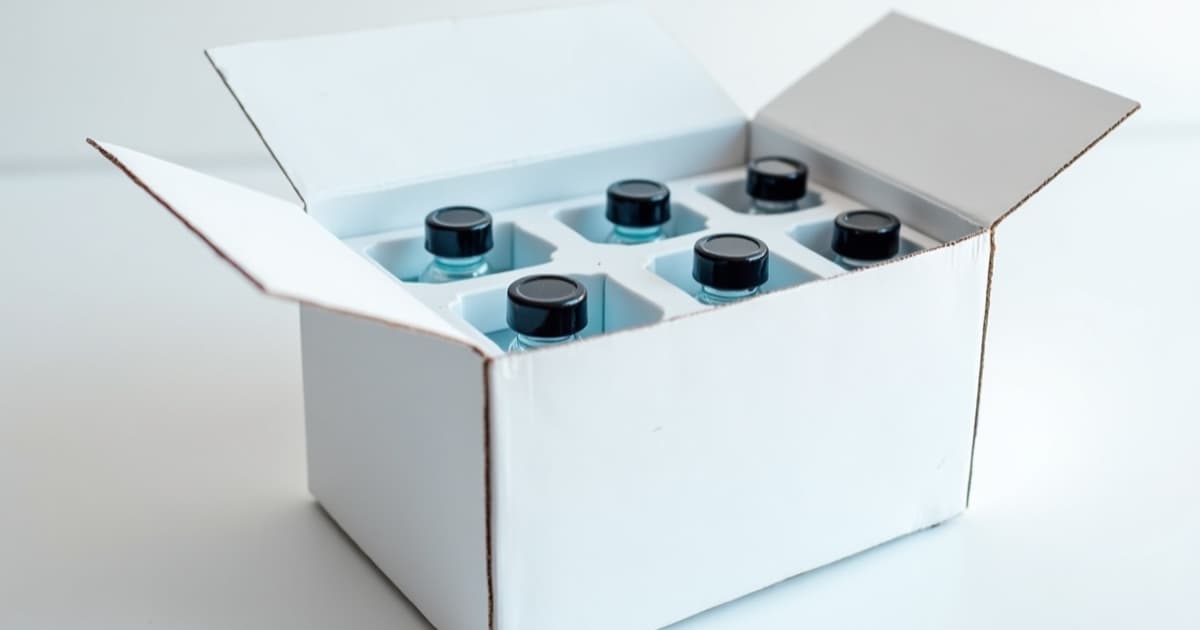
A lyophilised research peptide does not need to arrive cold, and a cold pack in the box is not evidence that it did. Dry peptide is stable at ambient temperature for the few days a shipment takes, because the degradation routes that matter all need water. What needs cold is a peptide already in solution — and that is not what ships. The confusion is worth resolving, because it leads people to judge a supplier by the wrong signal.
Why the dry state is forgiving
Freeze-drying removes water, and water is a reactant in the main ways a peptide falls apart: hydrolysis of the backbone, deamidation of asparagine and glutamine, and the hydration-dependent side of oxidation. Take the water away and those routes slow by orders of magnitude rather than by a margin.
What remains temperature-sensitive in a dry cake is minor over days: slow oxidation of methionine, cysteine and tryptophan where air is present, and physical changes to the cake at temperatures well above anything a courier produces. A few days at ambient, or even a warm van, is not where a lyophilised peptide is lost.
| State | Stable at ambient for | Long-term storage |
|---|---|---|
| Lyophilised, sealed | Weeks | −20 °C, desiccated |
| Lyophilised, opened | Days, if kept dry | −20 °C, desiccated |
| In aqueous solution | Hours to days | Aliquoted at −20 °C or −80 °C |
Why do some suppliers ship cold?
Three reasons, and only one is about the peptide. Some compounds genuinely are less stable dry — NAD+ and certain highly oxidation-prone sequences among them. Some products ship already in solution, which changes the answer completely. And some cold packs are there because a chilled box reads as careful handling, which is a marketing decision rather than a chemical one. A cold pack that arrived thawed tells you nothing either way, which is the practical problem with treating it as a signal rather than inspecting the vial on arrival.
Does a peptide that arrives warm need to be discarded?
Almost never, for a sealed lyophilised vial. The dry cake tolerates ambient and above for far longer than a shipment lasts. Two things are worth checking on arrival instead: that the vial is intact and still under vacuum or its original seal, and that the cake looks normal rather than melted, collapsed to a glassy film, or shifted to a liquid. A collapsed cake indicates the material went through a temperature well outside anything a courier route produces, and that is a real finding; a warm box is not.
What actually matters on arrival
The shipment is a short episode in the material's life. What determines whether it is intact when it is used is mostly what happens after the box is opened.
Get it to the freezer. Ambient for the transit is fine; ambient for three weeks on a bench is a different exposure. The clock that matters starts when the vial stops being stored properly.
Equilibrate before opening. Lyophilised peptide is hygroscopic. Opening a vial straight from −20 °C condenses atmospheric moisture into the powder, which reintroduces exactly the water the lyophilisation removed. Let a sealed vial reach room temperature first. This single habit prevents more degradation than any shipping decision.
Record the lot and the date. Both are trivial to capture now and impossible to reconstruct later, and the lot number is the only thing connecting the vial to its certificate.
Why equilibrate before opening rather than after?
Because the condensation happens in the seconds the cold vial is open to room air. A surface below the dew point pulls water out of the air onto itself, and a hygroscopic powder holds onto it. Opening first and warming afterwards means the moisture is already in the cake, and closing the vial traps it there. Warming the sealed vial first means the interior is at room temperature before any air exchange occurs — the same reason a cold lens fogs when carried indoors, applied to a powder that does not shed the water again.
Is −80 °C better than −20 °C for dry powder?
Marginally, and rarely enough to matter. For lyophilised material a conventional −20 °C freezer with a desiccant is adequate for years, and the dominant variable is moisture rather than temperature. The one meaningful caveat is the freezer type: a frost-free unit runs deliberate warming cycles to sublimate ice, which subjects everything inside to repeated temperature swings. A manual-defrost freezer is the better choice, and that distinction matters considerably more than the difference between −20 and −80.
Once it is in solution, the rules invert
Everything forgiving about the dry state stops applying the moment water is added. A reconstituted peptide is subject to hydrolysis, deamidation, oxidation and aggregation, and the useful life is days to weeks rather than years. Three consequences follow:
- Aliquot immediately. Single-use aliquots remove freeze–thaw damage entirely rather than reducing it.
- Label with the date and concentration. At the moment of reconstitution, not later.
- Do not treat the diluent's shelf life as the peptide's. The 28-day convention attached to bacteriostatic water describes the preservative, not the compound — the two are separate clocks and the shorter one governs.
Can a reconstituted peptide be re-lyophilised?
Physically yes, usefully rarely. Freeze-drying a solution that has been sitting does not reverse degradation that has already happened — it removes the water and leaves whatever the peptide has become. It also adds a freezing step and a concentration step, both of which are opportunities for aggregation. For a compound where recovering the material matters more than certainty about its state, it is an option. As routine practice it converts a known quantity into an unknown one.
What should a shipment include beyond the vials?
Lot numbers that match the labels, and a route to the certificate for each — not a specimen document for the compound, but the record for the batch in the box. That is the part of a shipment that carries information. Packaging can be reasoned about from first principles; a certificate tied to a lot cannot be reconstructed after the fact, and knowing which panel answers which question is what makes it worth having.
All products referenced here are supplied for laboratory and research use only. They are not drugs, foods, supplements or cosmetics, and are not for human or veterinary use.