Lyophilisation removes water without ever letting it be liquid, and that one constraint explains everything about how a peptide arrives. The solution is frozen, and the ice is turned directly into vapour under vacuum. Because the water never melts, the dissolved peptide never has a chance to move, degrade or concentrate: it is left behind in the shape the ice had, as a porous cake. Why the cake looks the way it does, why it takes up water, and why it sometimes collapses all follow from the process.
Three stages
| Stage | What happens | What it decides |
|---|---|---|
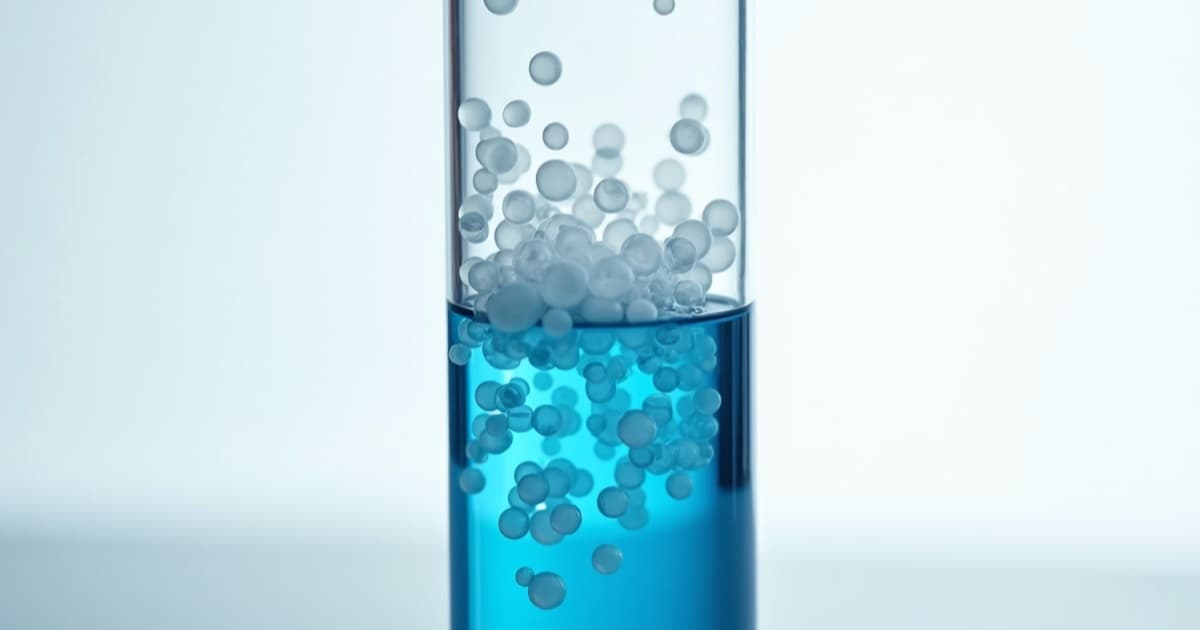
| Freezing | Solution cooled well below 0 °C; ice crystals form around the solute | Cake structure: crystal size sets pore size |
| Primary drying | Vacuum applied; ice sublimes directly to vapour | Removes ~95% of the water; longest stage |
| Secondary drying | Temperature raised; bound water desorbs from the solid | Final residual moisture, typically 1–3% |
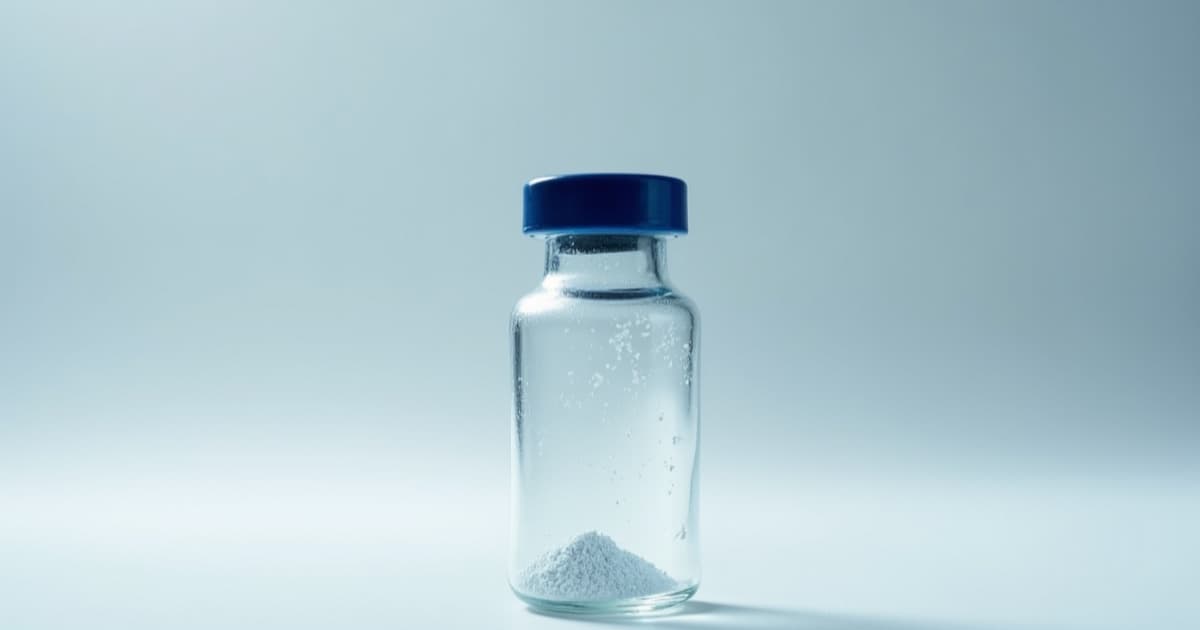
The result is a solid that occupies the volume the frozen solution did, minus the ice — which is why five milligrams of peptide can look like a wisp of white film, and why a vial can appear empty while holding exactly what its label says.
Why not just evaporate the water?
Because evaporation concentrates the solution as it goes. A peptide in a shrinking pool of liquid experiences rising concentration, rising salt, shifting pH, and a growing air–liquid interface — every condition that drives aggregation and degradation. Heat to speed it up and hydrolysis and oxidation accelerate too. Sublimation avoids all of it: the peptide is immobilised in ice from the first minute, and the water leaves as vapour from a solid. The process is slow and expensive precisely because it is gentle.
What is the collapse temperature?
The temperature above which the frozen solid can no longer hold its own shape during drying. Below it, the matrix stays rigid as ice sublimes and the pores it leaves stay open. Above it, the material softens, the structure slumps into a dense glassy layer, and the pores close — trapping water that secondary drying can no longer reach. A collapsed cake therefore has higher residual moisture and degrades faster in storage. Every formulation has its own collapse temperature, and primary drying is run a few degrees below it, which is the main reason the stage takes hours to days.
What the cake tells you
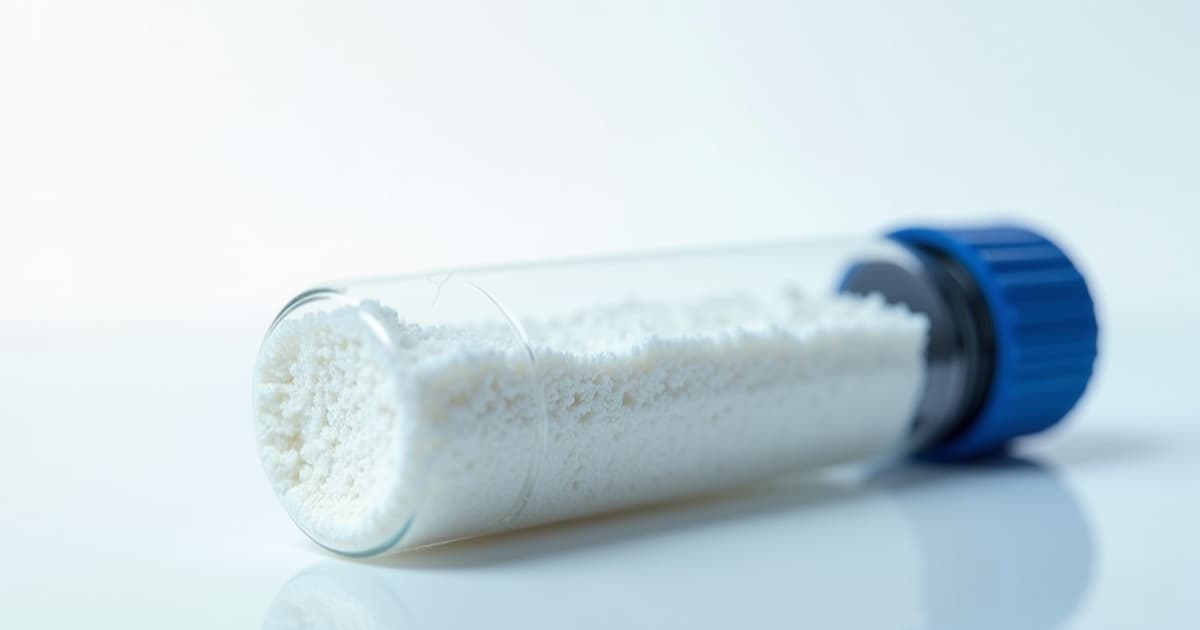
A well-run cycle leaves a uniform white cake with a fine porous structure. Departures from that are readable.
A cake that has shrunk from the wall or gone glassy went above its collapse temperature at some point — during drying, or later in a warm shipment. A cake that has broken into flakes was fine and was shaken; it is cosmetic. A cake that is sticky or partly liquid has taken up enough water to start dissolving itself, which means either a failed seal or a vial opened cold. Only the last is a real problem.
Why is the powder so eager to take up water?
Because of what makes it a good cake. The porous structure that lets water leave quickly during drying lets it return just as quickly: an enormous internal surface, all of it hydrophilic peptide and salt, exposed to whatever air enters the vial. Residual moisture after a good cycle is a few percent, and a lyophilised solid will climb well past that in minutes if opened into humid air while cold enough for condensation. Letting a sealed vial reach room temperature before opening is the whole precaution, and it matters more for a lyophilised cake than for almost any other solid.
Why do some vials contain more than the peptide?
Because a pure peptide at milligram scale does not always form a cake at all. A solution that dilute freezes to ice with almost nothing in it, and what remains after sublimation can be a film too thin to handle or to redissolve evenly. Formulations sometimes add a bulking agent — mannitol or a sugar — to give the cake body, and a lyoprotectant to stand in for the water the peptide loses. Where an excipient is present it should appear on the certificate, and it is part of the reason label mass is not peptide mass. Most research peptides are supplied without one, which is why their cakes are so slight.
Does lyophilisation change the peptide?
It should not, and the cases where it does are instructive. Freezing concentrates solutes into the liquid between ice crystals before everything solidifies, and for a brief period the peptide sits in a very concentrated, high-salt, pH-shifted pool. A sequence prone to aggregation can begin to aggregate there. Interfaces between ice and solution can unfold a structured peptide. Neither is common for short sequences, and both are why a certificate is issued on the lyophilised material rather than on the solution before drying — the process is part of what the batch record describes.
Why is a lyophilised peptide so much more stable than a solution?
Because water is a reactant in the main degradation routes, and lyophilisation removes it. Hydrolysis needs water. Deamidation proceeds through a water-dependent intermediate. Oxidation is slowed without dissolved oxygen. Molecules immobilised in a solid cannot diffuse to aggregate. The few percent of residual moisture is enough for slow chemistry over years, not fast chemistry over days — which is the difference between a shelf life measured in years dry and in weeks once water is added back.
All products referenced here are supplied for laboratory and research use only. They are not drugs, foods, supplements or cosmetics, and are not for human or veterinary use.