Reconstitution and dilution are two different problems, and the liquid that is right for the first is often wrong for the second. Reconstituting asks what will dissolve the solid and keep it stable in the vial. Diluting asks what the assay can tolerate. Those have different answers, and using one liquid for both is the commonest reason a solution behaves unexpectedly downstream.
What each common choice actually contributes
| Diluent | pH | Ionic strength | Best for |
|---|---|---|---|
| Sterile water | Unbuffered, drifts | None | Reconstitution where nothing should be added |
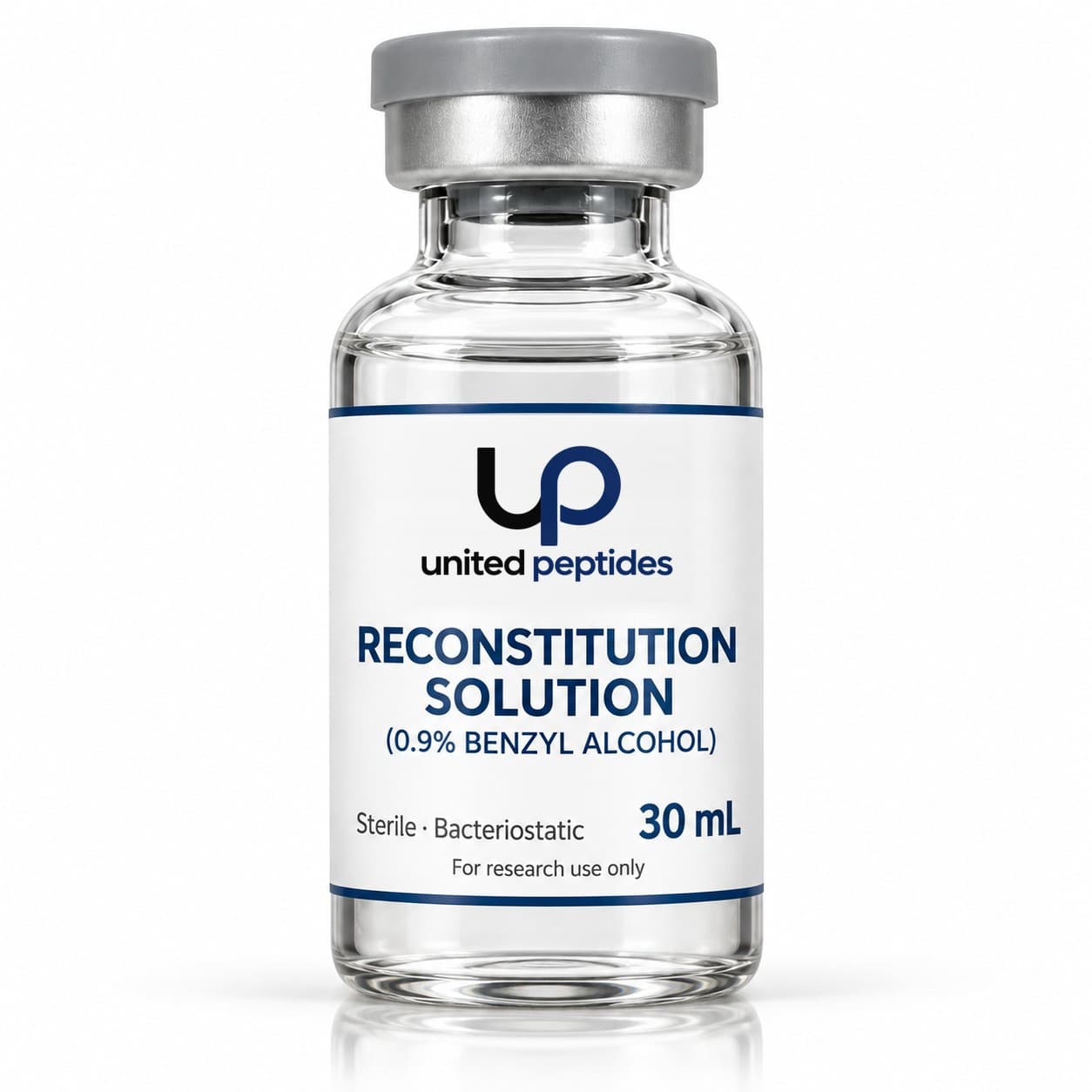
| Bacteriostatic water | Unbuffered | None | Multi-entry vials; contains 0.9% benzyl alcohol |
| Saline (0.9% NaCl) | Unbuffered | Physiological | Matching tonicity without adding buffer species |
| PBS | Buffered near 7.4 | Physiological | Dilution into assays that need a held pH |
| Dilute acetic acid | Low | Low | Dissolving basic peptides; volatile, so removable |
The pattern worth noticing is that water contributes nothing and therefore controls nothing. That is an advantage at the vial, where adding species you did not choose is undesirable, and a disadvantage downstream, where an unbuffered solution takes its pH from whatever it meets.
Why not just use PBS for everything?
Because a buffer is a set of ions, and ions interact with peptides. Phosphate in particular binds divalent cations, which matters for anything where a metal is part of the chemistry — a copper-binding peptide in phosphate buffer is in competition with the buffer itself.
Phosphate also sets the pH at roughly 7.4, which is near the isoelectric point of a good many peptides. A peptide at its pI carries no net charge and is at its least soluble, so diluting a marginal peptide into PBS is a reliable way to make it come out of solution. Water would not have done that, because water lets the peptide's own counter-ions set a pH it was already stable at.
Does saline behave differently from PBS?
In one important respect: saline supplies ionic strength without supplying buffering. That is sometimes exactly right — it matches tonicity for a cell system without introducing phosphate — and sometimes a trap, because an unbuffered solution at physiological salt will drift toward whatever pH the environment imposes.
For short exposures that drift is irrelevant. For a solution that will sit for hours, or one whose stability depends on being held away from a particular pH, it is the difference between a controlled condition and an uncontrolled one.
Why the reconstitution step is different
At the vial the priorities invert. Nothing added is one fewer thing to control for later, and the solution will be diluted many-fold before it reaches an assay, so its own composition matters less than its ability to dissolve the solid cleanly and keep it stable in storage.
That is why bacteriostatic water is the usual answer for a multi-entry vial: it dissolves most peptides, it adds only a preservative, and the preservative buys repeated entry which is the actual constraint. For a readily soluble peptide there is rarely a reason to reach for anything more complicated.
The exception is a peptide that will not go into water at all, where a different vehicle is needed and becomes part of the condition from that point on.
Can I reconstitute in water and dilute into buffer?
Yes, and for most work that is the right sequence. It keeps the stock simple and defers the buffering decision to the point where it is actually needed, which is also the point where the assay's requirements are known.
The one thing to watch is the transition itself. A concentrated aqueous stock meeting buffered saline can precipitate locally where the two first mix, even if the final concentration would have been fine. Adding the stock to moving buffer rather than buffer to stock avoids most of that, and it costs nothing.
Does the diluent affect how long the solution lasts?
Substantially, and in ways that are easy to predict once stated. Benzyl alcohol suppresses microbial growth, which is why a bacteriostatic solution tolerates repeated entry. Buffering holds the pH away from values where hydrolysis or deamidation accelerate. Ionic strength affects aggregation for peptides near their solubility limit.
None of that changes the chemistry of the peptide itself. A reconstituted solution has a horizon regardless of what it is dissolved in, and the diluent moves that horizon rather than removing it.
Matching the diluent to the destination
Three questions settle most cases, and they are worth asking in this order.
- Will the solution be entered more than once? If so, a bacteriostatic vehicle is doing real work. If it is single-use, the preservative is an additive with no benefit.
- Is the destination a cell system? Benzyl alcohol is cytotoxic at the concentrations present in bacteriostatic water, so a stock made with it needs enough dilution that the carry-through is negligible, or a different vehicle entirely.
- Does the assay need a held pH? If yes, buffer at the dilution step. If no, water keeps the condition simpler and the vehicle control easier.
What about peptides that need a metal present?
Those need the diluent chosen around the metal rather than around the peptide. A compound studied in a mitochondrial context, or anything where a chelating buffer component would compete, is a case where phosphate is a poor default and a non-chelating buffer or plain saline is the better starting point.
The general rule is that any buffer with affinity for divalent cations — phosphate, citrate, anything containing EDTA — is a participant rather than a bystander when a metal matters. Where the metal is the point of the molecule, the diluent choice stops being a convenience and becomes part of the experiment.
Should the diluent be recorded in a write-up?
Always, with its concentration where that applies. "Reconstituted in bacteriostatic water, diluted in PBS" is a complete description; "reconstituted and diluted as required" is not, and it is the kind of omission that makes a result impossible to reproduce for reasons nobody can identify.
The same applies to a vehicle control, which has to match the final composition rather than approximate it. A control missing the preservative, or carrying a different salt concentration, is not controlling for what the treated arm received.
Is there a default that is right more often than not?
For reconstitution, bacteriostatic water for a multi-entry vial and sterile water for a single-use one. For dilution, whatever the assay specifies, buffered if the exposure runs longer than minutes.
That covers most routine work. The compounds that need something else — the poorly soluble ones, the metal-dependent ones, the ones going into a system with unusual tolerance — are a minority and are generally known to be exceptions before anyone reaches for a bottle. Choosing a buffer and a pH deliberately is a decision worth making once per compound rather than once per experiment.
Where the diluent shows up in the result
Three ways, and all of them are avoidable once named.
Through the vehicle control. Whatever the peptide arrived in reaches the assay with it. A vehicle control that does not match the final composition is not controlling for what was added, and benzyl alcohol is the usual culprit because it is easy to forget it is there.
Through solubility at the point of mixing. A concentrated stock meeting a buffer at a different pH can precipitate locally, and fine precipitate is not always visible. The concentration afterwards is then lower than calculated and nothing announces it.
Through stability over the exposure. A solution sitting in an incubator for 48 hours is in a different chemical situation from one used within minutes, and the diluent determines how much the pH drifts during that time.
Does the order of mixing matter?
More than most protocols admit. Adding a concentrated stock into a larger volume of moving buffer keeps the local concentration low at every moment, so nothing ever sits briefly at a composition where it would come out of solution.
Adding buffer to a concentrated stock does the opposite: the first drops create exactly the conditions that cause precipitation, and whatever comes out may not fully redissolve. It is the same principle behind working a dilution series from dilute toward concentrated rather than the reverse.
Can a diluent be changed mid-study?
Only with an overlap, and it should be treated as seriously as a lot change. The diluent is part of the condition, so switching it changes the experiment in a way that can mimic a biological effect.
Running both in the same session, on the same assay, converts the change into a measured offset. Without that, any step in the data at the point of the switch is unattributable — it may be the diluent or it may be real, and nothing in the record distinguishes them.
Is there a diluent that suits storage as well as use?
Rarely the same one, which is why the two decisions are best made separately. Storage favours whatever keeps the peptide stable and uncontaminated over weeks — usually a simple vehicle with a preservative. Use favours whatever the assay tolerates.
Trying to satisfy both with a single liquid generally compromises one of them, and the compromise is usually made at the storage end where the consequences appear later and are harder to attribute.
All products referenced here are supplied for laboratory and research use only. They are not drugs, foods, supplements or cosmetics, and are not for human or veterinary use.