
Two laboratories can report different purity figures for the same vial without either of them being wrong, because a purity figure is the output of a method and not a property of the material. The number is the main peak's share of integrated area under one specific set of conditions. Change the conditions and the number moves, legitimately. The useful question is never which laboratory is right but which choices differed.
The choices that move the number
| Choice | Why it changes the figure |
|---|---|
| Detection wavelength | 214 nm sees the peptide bond; 280 nm sees only aromatic residues, so impurities without them vanish |
| Gradient and run length | A short run leaves late-eluting material on the column, uncounted |
| Integration baseline | Where the operator draws it decides how much of a shoulder belongs to the main peak |
| Solvent-front exclusion | What gets dismissed as injection artefact rather than impurity |
| Column chemistry and age | Resolution of close-eluting species, which merges or separates peaks |
| Sample concentration | Overloading broadens the main peak and can bury small neighbours |
None of those is misconduct. Each is a defensible decision that a competent analyst makes, and each shifts the result. A two-point gap between laboratories is entirely ordinary when the methods differ, which is why a certificate stating only "HPLC" has not stated a method.
Which single choice moves it most?
Wavelength, usually, and it is the easiest to overlook. At 214 nm the detector responds to the amide bond itself, so essentially every peptide-related species shows up. At 280 nm it responds to tryptophan and tyrosine, so an impurity lacking both is invisible — and truncation products frequently lack them, because the aromatic residue sat in the part that is missing.
A figure measured at 280 nm can therefore be substantially higher than the same sample at 214 nm, with no dishonesty involved. It is answering a narrower question.
How much disagreement is normal?
Between laboratories running genuinely similar methods on the same lot, a difference of a few tenths is routine instrument and operator variation. A gap of several points is a signal that something structural differs — the wavelength, the run length, or where the baseline was drawn — rather than a sign that one of them measured badly.
The distinction matters because the responses differ. Small scatter needs no action. A multi-point gap is worth resolving, because whichever figure you adopt becomes the basis for everything downstream.
How to find out which one moved
Three steps, in order of how much they cost.
Compare the stated methods first. Wavelength, column, gradient, run time. If one certificate says 214 nm and the other 280 nm, the investigation is finished and the lower figure is the more complete one.
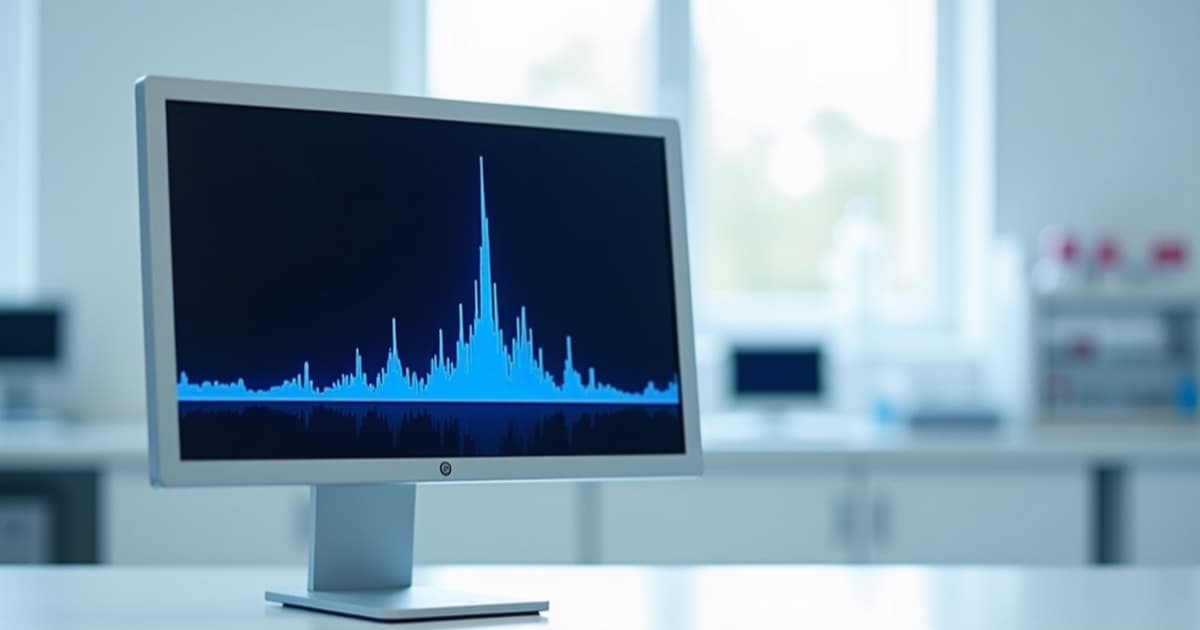
Then compare the traces, not the numbers. A chromatogram shows what a figure hides: whether the main peak is symmetrical, whether something co-elutes on its shoulder, and whether the run was long enough for late material to appear. Two traces side by side usually make the explanation obvious in a way two numbers never do.
Only then consider a third measurement. A referee run is worth paying for when the gap is large, the material is expensive, and the decision turns on it. It is not worth paying for to resolve a few tenths.
Could the two laboratories have tested different material?
It is the first thing to rule out and the easiest to miss. Two certificates for the same compound are not two certificates for the same batch, and the lot number is the only field that ties a document to a vial. Synthesis is a batch process and batches genuinely differ in impurity profile, so two lots can produce two honest and quite different figures.
The same applies within a lot if the sample was drawn at different times. A sample taken at release and one taken a year later are not the same material, whatever the label says.
Can the same laboratory disagree with itself?
Yes, and it is a useful control. Re-injecting the same sample twice on the same day typically agrees to a tenth or two; re-running it a month later on a different column may not, because columns age and resolution of close-eluting species degrades with use. A laboratory that reports its own repeatability is telling you how much of any gap is noise before you start attributing it to the material.
What if one laboratory reports a round number?
Treat it as a flag rather than a verdict. Instruments produce 98.4% and 97.9%; they rarely produce exactly 99%. A figure rounded to the unit has usually passed through a person, which does not make it wrong but does mean the underlying value is unavailable to you. Where two certificates disagree and one of them is round, the un-rounded one is generally the one with a measurement behind it.
Where disagreement matters most
The stakes are not even across a catalogue. For a compound used at high concentration in a tolerant assay, a two-point purity difference changes nothing anyone would notice. For a compound used near the limit of its solubility, or one where an impurity is plausibly active at the same target, the same two points can be the whole result.
The multi-receptor metabolic compounds are a case where it is worth caring. They are distinguished by which receptors they engage rather than by raw potency, so an impurity that is itself a truncation of the same sequence may retain activity at one of those receptors and not the others. A purity figure cannot tell you that; the identity of the impurity can.
Where two closely related compounds are being compared — one targeting a single receptor against one targeting two — a purity difference between the two lots is a confound in exactly the dimension the experiment is measuring. That is the situation worth resolving before running anything, rather than after.
Does an impurity being present mean it is active?
No, and assuming it is leads to over-caution as reliably as ignoring it leads to error. Most synthesis-related impurities are truncations and deletions that have lost part of the recognition motif and do nothing at the target. A few retain enough to bind weakly.
The chromatogram cannot distinguish those cases, because retention time reflects hydrophobicity rather than activity. What settles it is knowing what the impurity is, which usually means mass spectrometry on the fraction rather than a better purity number.
Which figure should I actually use?
The one whose method you can read and whose trace you have seen, measured on your lot. If that is the lower figure, use the lower figure. Adopting the more flattering number because it is more flattering is the one move that turns an ordinary methodological difference into a real problem later, when a result depends on a concentration that was never what it said.
And keep purity in its place. It is a proportion of the peptide-related material present, not a mass. Net peptide content is the figure that changes your arithmetic, and two laboratories agreeing on purity tells you nothing about it.
How should a disagreement be recorded?
Both figures, both methods, and which one the work used. A methods section that reports only the number it preferred has removed the reader's ability to reconcile it with anyone else's, and a discrepancy that was understood at the time becomes unexplainable later.
The short form is enough: the figure, the wavelength, the laboratory and the lot. Four items make a purity claim reproducible; one makes it an assertion. Where the two measurements were months apart, the dates matter as well, because material does change and a later lower figure may be describing real degradation rather than a methodological gap.
This is also the point at which keeping the chromatogram pays off. A stored trace can be re-examined when a question arises years later; a stored number cannot.
Does a third opinion settle it?
Only if the third laboratory's method is specified and differs from neither in an unexamined way. Commissioning another run without first comparing the two methods you already have usually produces a third number rather than an answer, and the cost falls on the buyer.
The sequence that works is cheapest-first: compare methods, then compare traces, then measure again only if the first two leave the question open. Most disagreements are resolved at the first step, because the wavelength or the run length differs and the explanation is immediate once anyone looks.
Underlying all of this is a habit worth adopting generally: treat a purity figure as the output of a procedure rather than a fact about a substance. Once a number is understood that way, a disagreement between two of them stops being a puzzle about honesty and becomes an ordinary question about which procedures were run. That reframing resolves most of these cases before any money is spent on a third measurement, and it makes the figures you do adopt considerably easier to defend later.
All products referenced here are supplied for laboratory and research use only. They are not drugs, foods, supplements or cosmetics, and are not for human or veterinary use.