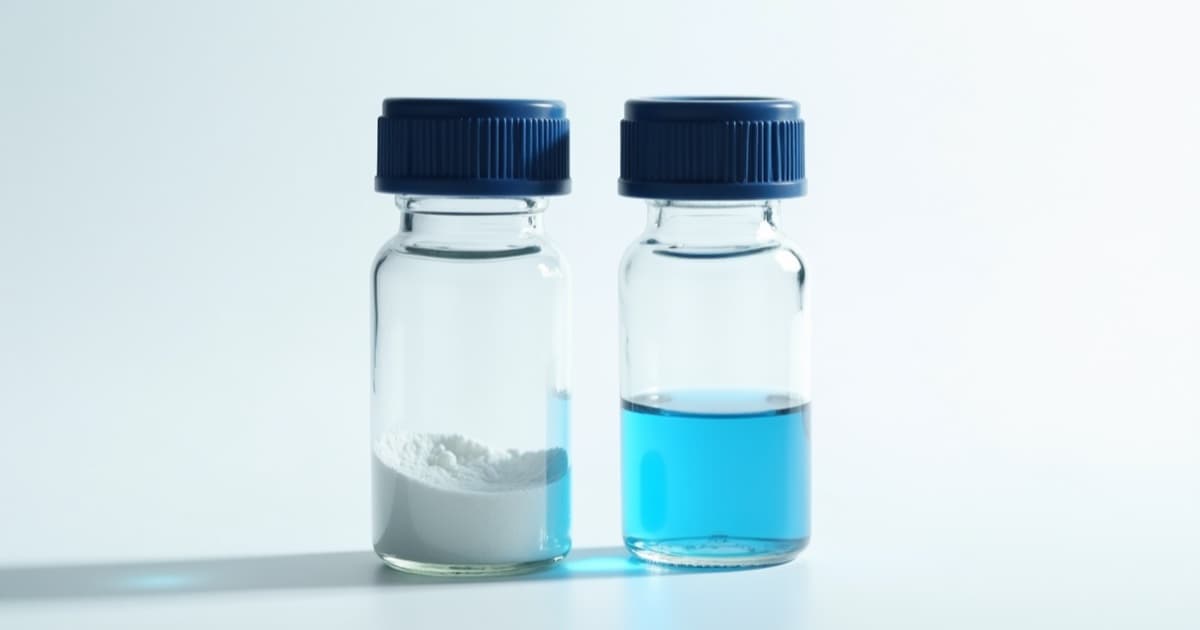
The larger vial is cheaper per milligram and more expensive per experiment, and which of those matters depends on how the material will be used. A 10 mg vial costs less than two 5 mg vials. It also has to be reconstituted all at once, and everything that happens to a solution — freeze–thaw, adsorption, degradation, the preservative's clock — happens to twice as much material. The saving is real; so is the exposure. The choice is about matching the vial to the work rather than to the price list.
What changes with the size
| Smaller vial | Larger vial | |
|---|---|---|
| Cost per mg | Higher | Lower |
| Material exposed on reconstitution | Less | All of it |
| Aliquots needed | Fewer | More, or a multi-entry stock |
| Concentration options | Limited by diluent volume in a small vial | Wider range |
| Lot consistency across a study | Several vials, possibly several lots | One vial, one lot |
| Loss if something goes wrong | One small vial | The whole supply |
The last two rows pull against each other, and they are the rows that usually decide it.
Why does the larger vial not simply win on cost?
Because a peptide is not consumed until it is used, and it is not stable indefinitely once dissolved. A 10 mg vial reconstituted for work that uses 2 mg over three months has put 8 mg through three months of solution chemistry to save the price of a second vial. If the surplus is aliquoted and frozen at reconstitution, most of that exposure is avoided and the saving is genuine. If it sits as a multi-entry stock in a refrigerator, a good fraction of it will not survive to be used, and the cheaper vial delivered less usable peptide than the dearer one would have.
When does lot consistency argue for the larger vial?
Whenever a result will be compared across the whole series of experiments. Two 5 mg vials may come from different lots, with different net peptide content, impurity profiles and counter-ion burden — ordinary variation, but variation. One 10 mg vial is one lot. For a series of experiments meant to be compared against each other, one lot aliquoted into many tubes removes a variable that would otherwise have to be tracked and corrected for. That is often worth more than the price difference, and it is the strongest argument for buying larger and aliquoting.
Matching the vial to the concentration
A vial has a fixed internal volume, and it sets the highest concentration that can be made in it. A 2 mL vial holding 5 mg can take at most about 1.5 mL of diluent comfortably, so the stock cannot be more dilute than roughly 3 mg/mL without transferring it out. A larger vial of the same mass allows a more dilute stock; a smaller one forces a concentrated stock and a transfer.
In the other direction, a very concentrated stock is where aggregation-prone sequences fail, so a small mass in a small vial can force a concentration the compound does not tolerate. Reading the vial's volume against the intended stock concentration is a five-second check that prevents a specific and annoying failure.
How does net peptide content change the arithmetic?
It scales both sizes equally, which means it does not change the choice but does change the numbers. A 10 mg vial at 80% content holds 8 mg of peptide; a 5 mg vial at the same content holds 4. The label mass is not the peptide mass in either case, and the certificate's figure is the one to plan from. What content does change is the comparison between lots: two 5 mg vials at 78% and 86% are not the same amount of peptide, and neither is the same as half of a 10 mg vial at 82%.
Is there a size below which vials become impractical?
Yes, and it is about handling rather than chemistry. Below a milligram or two, the material is a film barely visible in the vial, a meaningful fraction of it is lost to the stopper and the walls on reconstitution, and the mass cannot be checked by any bench method. Small vials suit potent compounds used at low concentration, where a milligram is a great deal. For anything used at milligram scale, a very small vial trades a small saving for a large proportional loss — and the vial looking empty stops being an illusion.
What is the usual right answer?
The larger vial, aliquoted at reconstitution, for any compound that will be used across more than one session. The smaller vial for a first look at a compound, for anything used rarely, and for anything whose stability in solution is poor enough that even frozen aliquots are a risk. The wrong answer in both directions is the same one: a large vial reconstituted and then drawn from repeatedly over weeks, which combines the cost exposure of the large vial with the chemistry exposure of a multi-entry stock. Aliquoting is what makes the larger vial the better buy, and without it the saving mostly evaporates.
Does the vial size affect the certificate?
Not the analytical panels, which describe the batch rather than the fill. What changes is the fill weight tolerance: a 10 mg fill and a 5 mg fill from the same lot are portioned from the same powder, and each is weighed to within a stated tolerance that is usually a percentage of the target. The absolute uncertainty on the smaller fill is therefore smaller, but the relative uncertainty is the same, and net peptide content applies to both identically. Two vial sizes of one lot are the same material at two masses; the certificate is the same document for both.
All products referenced here are supplied for laboratory and research use only. They are not drugs, foods, supplements or cosmetics, and are not for human or veterinary use.