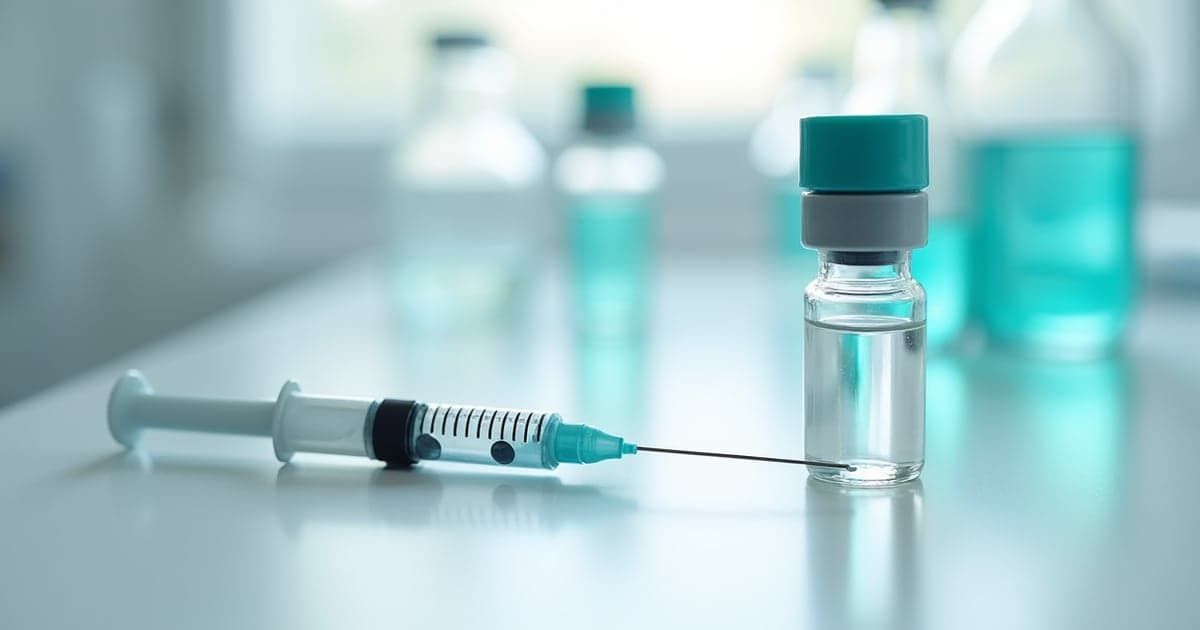
A syringe used for reconstitution is doing two unrelated jobs — measuring a volume and crossing a rubber septum — and the specifications that suit one work against the other. A fine needle protects the stopper and resists accurate filling. A wide one fills easily and cuts the septum. Most of the choice is deciding which of those costs matters for the work in front of you.
The four specifications that matter
Syringes are described by a long list of attributes, of which four change anything for this application.
| Specification | What it governs | Practical consequence |
|---|---|---|
| Barrel volume | Measurement resolution | A 1 mL barrel reads to roughly 0.01 mL; a 3 mL barrel cannot |
| Gauge | Needle bore, and damage to the stopper | Higher number means finer; 31G leaves a smaller track than 25G |
| Needle length | Whether the tip reaches the liquid | Short lengths suit small vials; long ones suit tall bottles |
| Dead space | Volume retained after full depression | Never delivered, and invisible on the graduations |
Barrel volume is the specification most often chosen wrongly. The graduations on a 1 mL insulin barrel are divided into a hundred marks, so a reconstitution volume can be read to about one part in a hundred. The same volume drawn into a 3 mL barrel occupies the bottom third of the scale, where the marks are coarse and the reading is approximate. Since the volume sets the concentration, resolution at this step propagates into every number downstream.
What is dead space, and does it matter here?
It is the liquid remaining in the needle hub when the plunger is fully depressed — drawn up, paid for in the measurement, and never delivered. For adding solvent to a vial it is largely harmless: the syringe is emptied into the vial and the residue stays behind in a tool that is about to be discarded, so the delivered volume falls slightly short of the reading. Draw 1 mL, deliver a little under 1 mL.
Where it does matter is any attempt to use a syringe for accurate transfers out of a vial, which is why a pipette is the better instrument in that direction. The honest summary is that a syringe is a good delivery device and a mediocre measuring device, and the way to live with that is to draw slightly over the nominal volume, or to accept the small shortfall and record the concentration as approximate.
Why does gauge matter if the needle is only used once?
Because the stopper is used more than once. Every entry cuts a track through the rubber, and a wider needle removes more material. Enough passes with a wide needle and the septum stops resealing, at which point the vial is no longer closed and the seal that was keeping a hygroscopic solid dry is gone. A multi-entry vial's lifespan is set by its stopper rather than by the contents, and gauge is the main variable within your control. A 31-gauge needle — the gauge on our 1 mL insulin syringes — is about as fine as remains practical for drawing a bacteriostatic solution.
What is coring?
A needle punching out a disc of rubber rather than parting it, leaving a fragment in the solution and a hole in the stopper that will not close. It happens more readily with wide, blunt or previously used needles, and it is largely preventable by technique: enter at an angle of roughly 45 degrees, then straighten as the bevel passes through, so the point parts the rubber instead of stamping it. A visible fragment floating in a reconstituted solution means the vial has been compromised twice over — particulate in the liquid and a stopper that no longer seals.
Matching the syringe to the volume
Reconstitution volumes in peptide work are usually between 0.5 mL and 3 mL, and a 1 mL barrel covers most of that range at good resolution. Above about 2 mL the choice is between two draws with a 1 mL barrel and one coarse draw with a larger one, and two accurate draws are generally preferable — each one is read near full scale, which is where any volumetric instrument is most accurate.
Needle length interacts with the container rather than the volume. A short needle reaches the liquid in a small vial comfortably but may not reach into a 30 mL solvent bottle once it is part-used, which is a nuisance rather than a problem: the bottle can be inverted. The fixed-needle insulin format is usually the right compromise for reconstitution work precisely because it minimises both gauge and dead space in one design, at the cost of being unable to change needles between the solvent bottle and the peptide vial.
Should the same needle enter the solvent bottle and the peptide vial?
With a fixed-needle syringe there is no alternative, and the sequence matters: solvent first, then the peptide vial, never the reverse. A needle that has been in the peptide vial carries peptide residue into a shared solvent bottle, which cross-contaminates every subsequent vial drawn from it. Where needles are detachable, changing between the two is cheap insurance. Either way the stopper of each container gets an alcohol wipe before entry and a moment to dry, since a wet septum distributes contamination rather than removing it.
Does the syringe material affect the peptide?
For the seconds a solvent spends in transit, no. Over longer contact, yes — peptides adsorb to plastic surfaces, and the effect grows as concentration falls. The practical rule is that a syringe is for transfer, not storage. A reconstituted solution left in a syringe for hours is in contact with a large plastic surface area and a lubricated rubber plunger seal, neither of which belongs in a storage decision. Material intended to keep belongs in aliquots in appropriate tubes.
What the choice does not fix
Syringe selection addresses volume accuracy and septum integrity. It does not address the solvent question, which is separate and matters more: whether the vehicle contains a bacteriostatic agent determines how long a multi-entry vial remains usable, and no needle choice compensates for the wrong vehicle. Our reconstitution kit pairs a 30 mL bacteriostatic solution with 31-gauge syringes and prep pads for this reason — the three decisions are usually made together, and getting one right while getting another wrong produces the same outcome as getting both wrong.
Nor does it address what goes on the vial afterwards. A reconstituted vial needs its date and concentration recorded on it, because a clear solution in a glass vial is indistinguishable from any other clear solution in a glass vial, and the stability clock starts at reconstitution.
All products referenced here are supplied for laboratory and research use only. They are not drugs, foods, supplements or cosmetics, and are not for human or veterinary use.