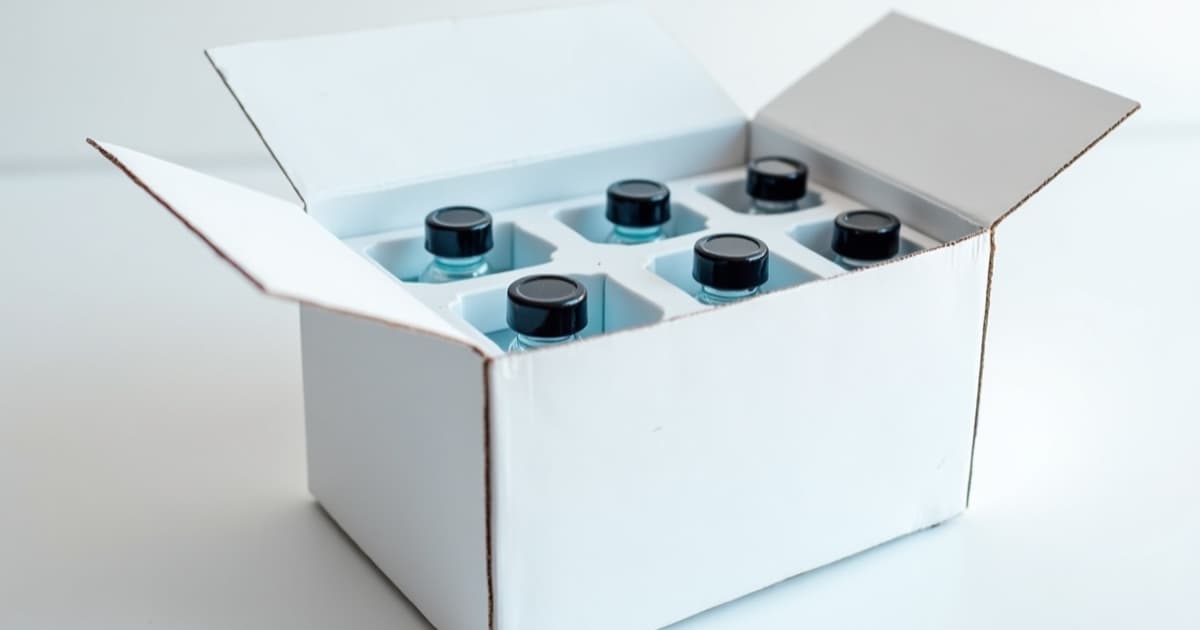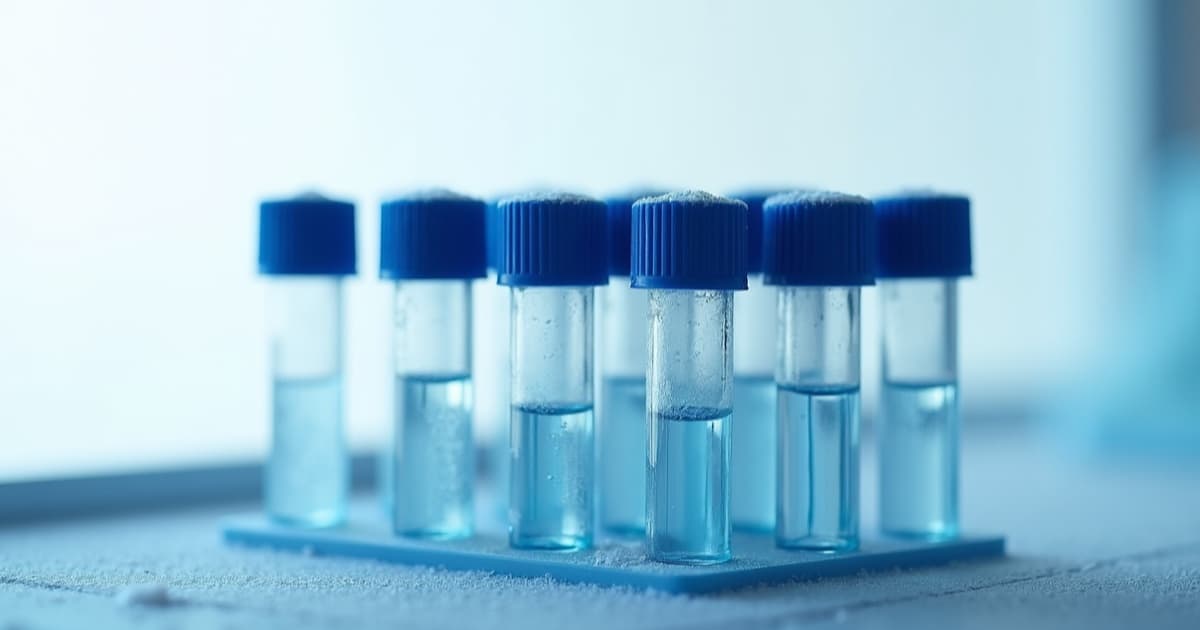
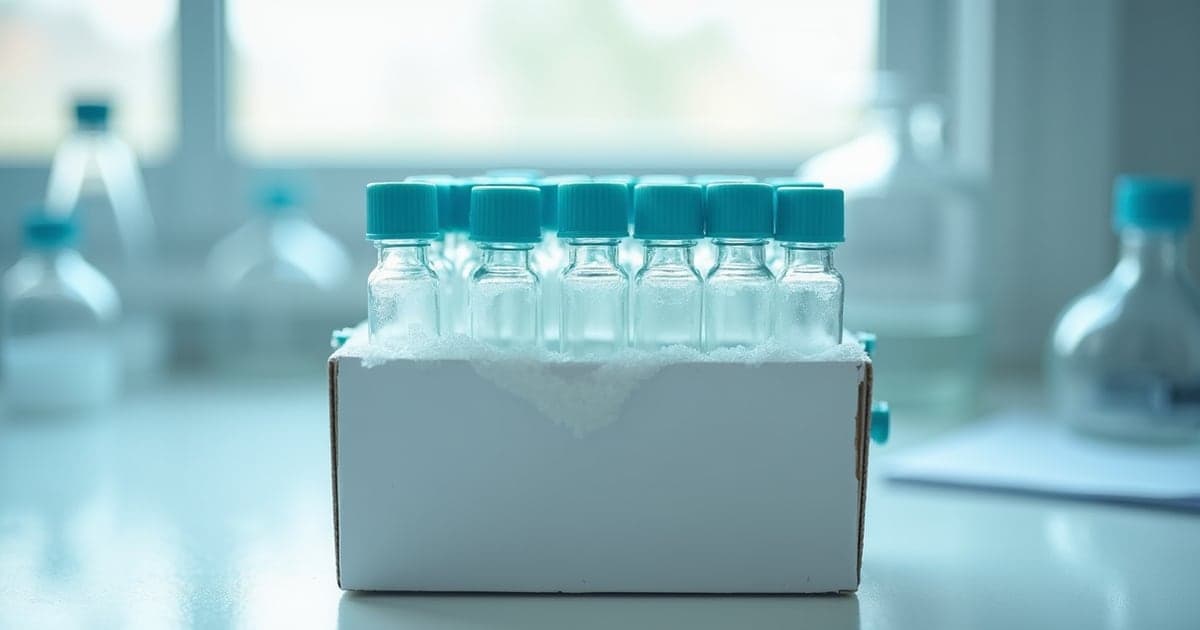
Temperature changes the rate of every degradation reaction without changing which reactions are available, so storage is a question of how much you slow the chemistry rather than whether you stop it. The more consequential variable is usually not the temperature at all. Whether the material is dry, sealed and undisturbed matters more than ten or twenty degrees in either direction, which is why a sealed vial on a shelf often outlasts an opened one in a freezer.
What each condition is actually for
Three conditions cover nearly all peptide storage, and they are not simply a ranking from worse to better — each one is a different trade.
| Condition | What it controls | Appropriate for |
|---|---|---|
| Room temperature, sealed and dry | Nothing actively; relies on the absence of water | Short holds, transit, material in use within days |
| 2–8 °C | Slows hydrolysis and oxidation severalfold | Reconstituted solutions in active use |
| −20 °C | Slows chemistry substantially; water is frozen | The default for lyophilised solids and most aliquots |
| −80 °C | Slows it further; eliminates residual mobility | Long holds, reference material, scarce lots |
The pattern worth noticing is that the first row controls degradation by removing the reactant rather than by cooling. A sealed lyophilised peptide has very little water available, and most of the reactions that destroy peptides need water. That is why dry material tolerates ambient transit in a way a solution never would, and why the seal is the component that matters most.
Does −80 °C justify the freezer space?
For working stock, rarely. For a sealed, properly dried solid the limiting factor is not molecular mobility — it is already low — but moisture ingress and oxygen, neither of which a colder freezer addresses. Where −80 °C earns its place is for material held for years, for a reference lot that must stay comparable to itself, or for a sequence with a known structural liability. For a vial that will be opened within a few months, −20 °C and a good seal is the better-engineered answer.
There is also a cost to colder storage that is easy to overlook: every retrieval from a −80 °C freezer involves a larger temperature excursion and a longer warm-up, during which condensation forms on and in a cold vial. For material accessed often, the handling penalty can exceed the storage benefit.
Is a desiccant worth adding to stored vials?
For opened vials, yes, and it is the cheapest intervention available. Once the seal is broken the limiting factor is moisture, and a desiccant in the storage box addresses the actual mechanism rather than a proxy for it. For sealed vials it adds nothing — the seal is already doing that job better than a sachet can. The one caution is that a saturated desiccant is worse than none, because it becomes a moisture reservoir sitting next to the material it was meant to protect; the indicating kind exists so that this is visible rather than assumed.
Why is condensation the real risk when taking a vial out?
Because a vial straight from a freezer is below the dew point, so atmospheric moisture condenses on every cold surface — including the inside, the moment the stopper is removed. A hygroscopic solid will take that water up, and it does not leave again. This single mechanism causes more degradation in practice than the choice between freezer temperatures, and the fix costs nothing: let the closed vial reach room temperature before opening it. Fifteen to thirty minutes on the bench, unopened. A cake that has gone sticky or shrunken has usually met water this way rather than in shipping.
The form you are storing changes the answer
A single compound passes through three states, and each has its own horizon. Treating them as one thing is the common error.
Sealed lyophilised solid. The most stable form by a wide margin, because water, oxygen and light are all largely excluded at once. Storage recommendations for this form are conservative, and the gap between the recommendation and the actual tolerance is substantial.
Opened lyophilised solid. Materially less stable than sealed, for the moisture reason above. An opened vial stored dry and cold is fine, but the seal advantage is spent and will not come back. Desiccated storage genuinely helps here.
Aqueous solution. The shortest horizon, by a long way, and the one where temperature does the most work. Hydrolysis, oxidation and adsorption all run in solution and all respond to cooling, which is why reconstituted material is refrigerated for use and frozen in aliquots for keeping.
Does freezing a solution damage the peptide?
The freezing itself is not usually the problem; the cycling is. Each freeze–thaw pass concentrates the solute as ice forms and exposes the molecule to an interface it would not otherwise meet, and the damage accumulates per cycle rather than per unit of time frozen. This is the entire argument for single-use aliquots — not that freezing is harmful, but that a tube frozen once and thawed once has met the mechanism once. A stock thawed twenty times has met it twenty times, and no storage temperature compensates for that.
What about storing a peptide in the freezer's door?
Avoid it, for a reason that has nothing to do with the nominal temperature. The door is the warmest part of a freezer and the part that cycles most, so material stored there experiences repeated partial thaws that a stable shelf position does not. A freezer that self-defrosts compounds this deliberately, running warming cycles as a design feature. For anything intended to keep, a manual-defrost freezer or a stable interior position is the meaningful choice — more meaningful than the difference between two nominal set points.
What the supplier's recommendation does and does not tell you
A stated storage condition is a recommendation for maintaining the material in its released state, not a cliff beyond which it fails. Our lyophilised material is specified for −20 °C, protected from light and moisture, with reconstituted solution refrigerated — which is the condition under which the release specification is expected to hold. It is not a claim that one warm afternoon destroyed anything.
What it also is not, and this is worth being clear about, is a shelf life. A certificate describes a sample on a date; a retest date or an expiry is a separate claim that requires stability data, and most research peptide certificates do not carry one. Absent that data, the honest position is that the certificate describes release condition and everything after release is a function of storage and handling — which puts the record of how material was stored on the same footing as the certificate itself. Keeping that record is ordinary good practice rather than a regulatory burden.
All products referenced here are supplied for laboratory and research use only. They are not drugs, foods, supplements or cosmetics, and are not for human or veterinary use.