Peptide work generates four distinct waste streams, and the hazard in most of them is the needle or the solvent rather than the peptide. That is worth stating at the outset because it determines where the care belongs. A sharps injury is an immediate physical hazard; a few milligrams of a research peptide on a bench is a contamination problem. Both need handling, and they need different handling.
One qualification governs everything below: the specific requirements that apply to you are set by your institution's environmental health and safety office and by local and national waste regulation, and they vary by jurisdiction and by institution. Nothing here substitutes for those rules. What follows is the reasoning behind the categories, which is what makes the rules legible once you read them.
The four streams
| Stream | Typical items | Primary concern |
|---|---|---|
| Sharps | Needles, syringes with needles attached, broken glass | Puncture injury; never the peptide |
| Chemical | DMSO and organic solvent stocks, acid or base solutions | The solvent's own hazard profile |
| Aqueous peptide waste | Spent dilutions, rinses, expired reconstituted vials | Usually low; governed by local drain policy |
| Solid and dry | Empty vials, tips, wipes, residual lyophilised powder | Dust and surface transfer |
The sharps stream is the one with a genuine injury risk, and it is the one most often compromised by convenience. A fixed-needle insulin syringe goes into the sharps container whole, because the needle cannot be separated from it. Recapping before disposal is where a large share of needlestick injuries occur, and the container exists so that recapping is unnecessary.
The chemical stream is classified by the solvent, not by the peptide. A DMSO stock is DMSO waste and carries DMSO's requirements — which include the fact that it penetrates skin readily and will carry dissolved solutes through with it. That property is the reason DMSO deserves more respect than its mildness suggests, and it applies to the waste exactly as it applies to the stock.
Can peptide solutions go down the drain?
That is a question for your institution's policy and your local water authority, not one that can be answered generally, and the answer differs between a university building on a municipal system and a facility with its own discharge consent. What can be said is what the policy will turn on: the solvent present, the total quantity, and whether anything else in the solution is regulated. A dilute aqueous peptide rinse and a millilitre of DMSO stock are different disposals regardless of the peptide in them.
The practical approach is to find out once, write the answer into the protocol, and stop improvising per experiment. Disposal is the step most likely to be decided at the bench by whoever is clearing up, which is exactly how an inconsistent practice becomes an established one.
What does a lyophilised powder spill need?
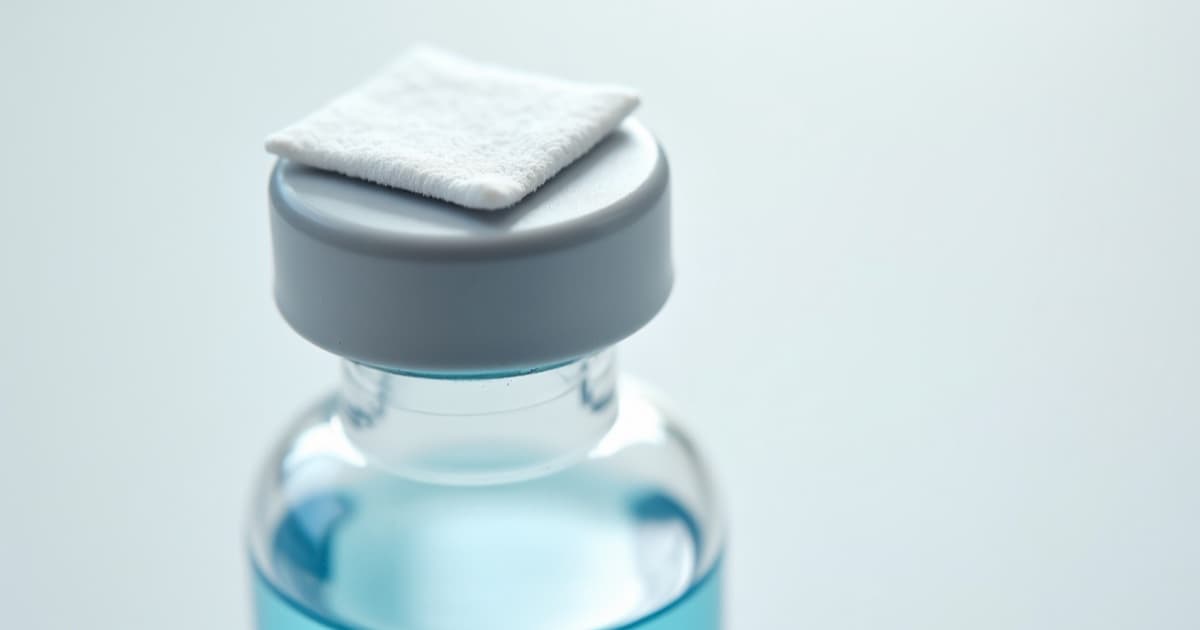
Containment before cleaning, because the failure mode is aerosolisation. A few milligrams of a low-density lyophilised solid disperses from a surprisingly small disturbance — a dropped vial, a sharp exhale, a fan — and sweeping or brushing it makes the problem worse by putting it into the air. The sequence that works is to stop air movement, cover the material with a slightly damp wipe to bind it, then collect the wipe. Damp, not wet: a wet wipe spreads a soluble solid outward.
Static is the compounding factor. Lyophilised powders carry charge readily, so material travels to the nearest grounded surface and clings there, which means a spill is frequently larger in extent than it looks. Wiping outward from the centre and covering more area than appears necessary is the right instinct. A few milligrams genuinely looks like almost nothing, and that illusion works in both directions — a vial can look empty when it is full, and a spill can look trivial when it has travelled.
What about a broken vial of reconstituted solution?
Two hazards at once, and the glass is the urgent one. Sharps first, with forceps or a scoop and never with gloved fingers, into the sharps container. Then the liquid, absorbed rather than wiped, then the surface decontaminated according to local practice. Gloves and eye protection throughout, and the glove change happens before anything else is touched — a torn glove with solution on it transfers to every surface the hand then meets.
Decontaminating a surface afterwards
Most peptides are not chemically robust, which works in your favour here: they are readily denatured and hydrolysed by ordinary laboratory decontaminants. The thing to be clear about is what each agent achieves, since the common error is assuming one step did two jobs.
A 70% alcohol wipe removes and disperses residue, and it is appropriate for routine bench cleaning. It is not a reliable way to destroy peptide material. A dilute bleach solution does degrade peptides effectively, and it is the right choice where destruction rather than removal is the goal — at the cost of corroding metal surfaces and requiring a rinse. Neither addresses endotoxin, which is far more robust than any peptide and survives treatments that destroy proteins entirely; that distinction matters whenever glassware will be reused for endotoxin-sensitive work.
For the routine case — a drop of solution on a bench — alcohol is proportionate. Reserve the stronger measure for quantities that justify it.
Do empty vials need special disposal?
A vial that held a few milligrams of lyophilised material and has been rinsed is ordinary glass waste under most policies, and glass goes to sharps or a designated glass stream rather than general waste because of the breakage risk. An unrinsed vial with visible residue is a chemical disposal question. The rinse is the step that moves it between categories, and whether the rinsate itself needs collecting is the same local question as above.
Worth separating from disposal entirely: the label and the arrival record are part of the material's history, and discarding the vial does not discharge the record. A disposal record is part of ordinary good laboratory practice — what was disposed of, when, and by what route.
Where do safety data sheets fit?
They are the document that answers the hazard question for a specific material, and they are the right starting point before any disposal decision. Ours are published at Safety Data Sheets. The section on handling and disposal states what is known for that compound, and where the honest answer is that comprehensive toxicological data do not exist for a given research peptide, the sheet says so rather than implying a clean bill of health. That absence of data is itself the reason for handling research material conservatively: unknown hazard is not the same as no hazard, and the appropriate default is the cautious one.
All products referenced here are supplied for laboratory and research use only. They are not drugs, foods, supplements or cosmetics, and are not for human or veterinary use.