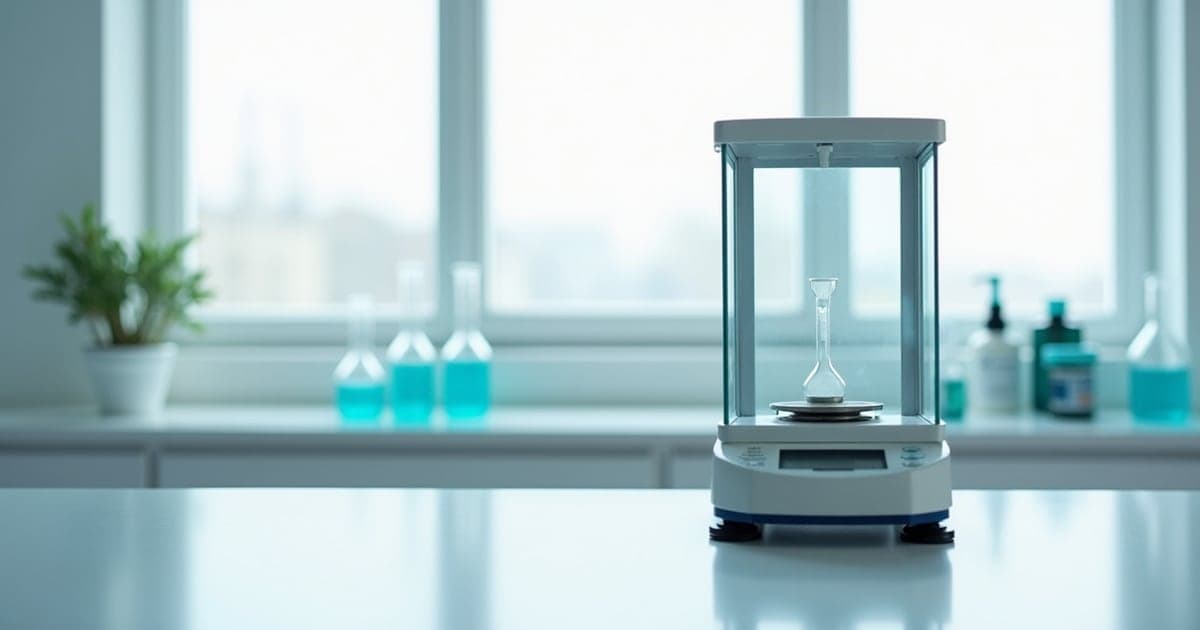
A lyophilised peptide is close to the worst-behaved solid an analytical balance will ever be asked to weigh, which is why most laboratories avoid weighing it and dissolve the whole vial instead. It is light enough that static moves it, hygroscopic enough that its mass changes while you watch, and usually present in quantities near the limit of what an ordinary balance can resolve.
Three problems, all at once
Static. A dry, low-density powder picks up charge readily, and a charged particle is attracted to or repelled by every surface near it. The visible symptom is powder climbing the side of a weighing boat or leaping off a spatula; the invisible one is a balance reading that drifts because the pan is experiencing an electrostatic force as well as a gravitational one.
Water uptake. The solid is hygroscopic by construction — lyophilisation produces a porous cake with enormous internal surface area, which is exactly the structure that takes up atmospheric moisture fastest. An exposed sample gains mass continuously, so the reading rises while the operator watches and the "stable" value is a judgement rather than a fact.
Resolution. Weighing 2 mg on a balance reading to 0.1 mg means the smallest division is 5% of the measurement. Weighing it on one reading to 0.01 mg is far better, but those balances are more sensitive to draughts, vibration and the static problem above.
| Approach | What it avoids | What it costs |
|---|---|---|
| Dissolve the whole vial | Weighing entirely | No choice of final concentration from one vial |
| Weigh by difference | Transfer losses; static on the boat | Two weighings instead of one |
| Weigh out onto a boat | Nothing in particular | Static, transfer loss, moisture gain |
| Dissolve, then aliquot by volume | All of the above | Volumetric error instead |
Why is dissolving the whole vial the usual answer?
Because the vial's contents are already a known mass, stated on the label and characterised on the certificate, and because dissolving in a measured volume converts a difficult mass measurement into an easy volume one. Concentration is mass over volume, and the mass term comes free if the whole vial goes in.
It also removes every handling loss at once. Nothing is transferred, nothing sticks to a spatula, nothing blows away. For a vial supplied at a convenient fill this is almost always the right move, and it is why peptides are sold in small fixed quantities rather than in bulk jars.
What is weighing by difference?
Weighing the source container before and after dispensing, rather than weighing the dispensed material. The difference is the mass that left, and it does not matter what stuck to the spatula on the way out or what remained in the receiving vessel — neither affects the subtraction.
It is the standard technique for exactly this class of problem and it removes transfer loss completely. What it does not remove is moisture uptake during the operation, because both weighings happen on a sample that is exposed to air at different times.
Handling static
Static is the problem most likely to produce a visibly absurd result, and it has practical fixes.
Let everything reach room temperature first. A vial straight from a freezer is cold, which drives condensation and encourages charge. Equilibrating a sealed vial before opening it addresses the moisture problem and the static problem together.
Use metal or antistatic plastic rather than ordinary polystyrene for weighing vessels, and avoid wiping anything with a dry tissue immediately beforehand, which is an efficient way to charge it. An ioniser removes the problem outright where one is available, and a slightly humid room helps more than people expect.
Why does humidity cut both ways?
Because the same moisture that suppresses static also gets absorbed by the powder. A dry room makes material fly; a humid room makes it gain mass. Neither extreme is comfortable, and the usual compromise is ordinary ambient humidity with the sample exposed for as short a time as possible.
The short-exposure principle matters more than the humidity level. Open, dispense, close — measured in seconds rather than minutes — keeps the moisture gain small enough to ignore regardless of the room.
How much does moisture uptake actually change the mass?
Enough to see on a sensitive balance within a minute or two for a freshly opened hygroscopic cake, and enough over longer exposures to matter at milligram scale. The compounding problem is that the water taken up is indistinguishable from peptide on the balance, so it inflates the mass and therefore deflates the real concentration of whatever is made from it.
That is the same error already present in the vial at a smaller scale: residual water is part of why a 5 mg vial holds less than 5 mg of peptide. Weighing in a humid room simply adds to a correction that already exists.
Which compounds are worst for this?
The very light fills and the deliquescent ones. A short peptide supplied at a small fill presents the least material against the most balance error, so the proportional uncertainty is highest there.
A thiol compound adds a second reason to minimise exposure that has nothing to do with the balance: time open is time oxidising. For anything in that category the argument for dissolving the whole vial rather than weighing a portion is stronger again.
When weighing is genuinely necessary
Three situations call for it, and all of them reward preparation.
- Bulk material. A gram-scale supply cannot be dissolved whole, so a portion has to be taken. At that scale the balance problems largely disappear — weighing 200 mg is straightforward in a way weighing 2 mg is not.
- A concentration the vial size does not give. Usually better solved by dissolving the whole vial and diluting, which trades a hard mass measurement for an easy volumetric one.
- Preparing a reference standard. Here accuracy genuinely matters and the effort is justified, including verifying the result by quantitation rather than trusting the balance alone.
Should the balance reading be corrected for net peptide content?
Yes, and forgetting to is the single commonest error downstream of a correct weighing. The balance reports the mass of powder, and the powder is peptide plus counter-ion plus water plus any excipient. Using the balance figure as a peptide mass overstates it by whatever the content figure says.
Apply the correction once, at the point the stock is made, rather than carrying a nominal figure forward. That is the same discipline as for a whole-vial reconstitution and for the same reason: a correction applied once is reliable, and one that has to be remembered at every step eventually is not.
Verifying what you weighed
A balance reading is a hypothesis about how much peptide is present, and for anything consequential it is worth testing rather than trusting.
The independent check is quantitation on the resulting solution: measure the concentration of what was made and compare it against what the weighing predicted. Quantitation against a standard reports peptide rather than powder, so it folds in the content correction and every handling loss at once.
A discrepancy between the two is informative rather than alarming. Consistently low means material is being lost in transfer, or the content figure is not being applied. Consistently high suggests moisture gain during the weighing. Either way the correction becomes known for that workflow and stops being a per-batch mystery.
Does the vessel matter?
Enough to be worth choosing deliberately. Weighing directly into the vessel the solid will be dissolved in removes the transfer step entirely, which removes the largest single loss. Where that is not possible, antistatic weighing boats and metal spatulas beat plastic ones.
What does not work is weighing onto paper, which holds static well and releases powder badly. The material left behind is a loss that nothing in the record accounts for, and it is larger than it looks.
Should a weighed portion be used immediately?
Yes, for a hygroscopic solid, and the reason is the same one that argues against weighing at all. Every minute between weighing and dissolving is a minute of moisture uptake against a mass that has already been recorded, so the recorded figure drifts away from the truth after the balance reads.
Dissolving straight away freezes the error at whatever it was at the moment of weighing. Leaving a weighed portion on a bench while something else is prepared lets it grow, and a cold vessel makes it grow considerably faster because condensation adds to absorption.
Is a microbalance worth it?
Only where the work genuinely requires weighing at single-milligram scale repeatedly. A balance reading to 1 µg resolves the mass comfortably, but it is correspondingly more sensitive to the static, draught and vibration problems above, so the limiting factor shifts from the instrument to the environment around it.
For most laboratories the money is better spent avoiding the weighing altogether — buying the fill size that matches the intended concentration, and dissolving the vial whole.
All products referenced here are supplied for laboratory and research use only. They are not drugs, foods, supplements or cosmetics, and are not for human or veterinary use.