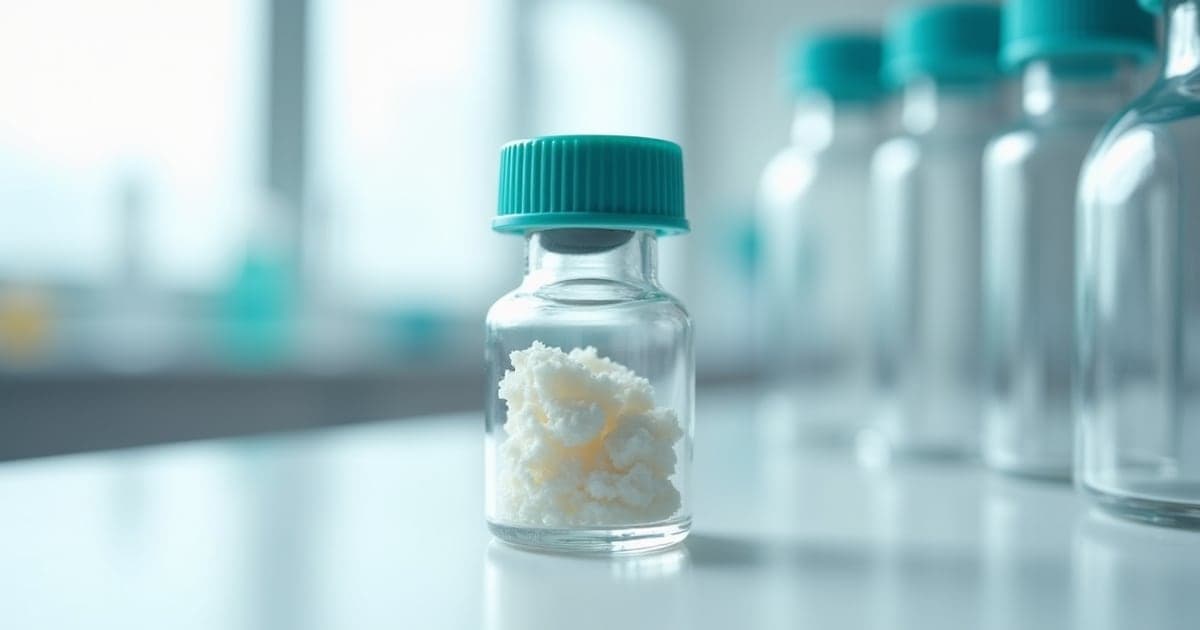
An excipient is anything deliberately added to a vial that is not the peptide, and the commonest reason for adding one is that a few milligrams of solid cannot be freeze-dried into a usable cake on its own. It is a manufacturing necessity rather than a filler in the pejorative sense. But it is also mass, it is also part of what you weigh, and a certificate that does not mention it leaves a gap in the arithmetic.
What a bulking agent is actually for
Lyophilisation works by freezing a solution and removing the ice by sublimation, leaving the dissolved solids behind in the shape the frozen solution occupied. The cake is a skeleton of what was dissolved. With enough solute that skeleton holds together; with very little, there is not enough material to form a structure.
Below roughly a couple of percent solids, the result tends to collapse into a film on the glass, or lift and blow out of the vial during drying. A bulking agent supplies the structure, and the peptide rides along inside it.
| Excipient | Role | What it changes for you |
|---|---|---|
| Mannitol | Bulking agent; crystallises into a firm cake | Adds mass; dissolves readily; largely inert in most assays |
| Sucrose or trehalose | Lyoprotectant; stabilises during drying | Adds mass; can interfere with assays that detect sugars |
| Buffer salts | Hold pH during and after drying | Fixes the pH of the reconstituted solution for you |
| Nothing added | Peptide plus counter-ion and water only | Cake may be a thin film or barely visible |
How can I tell whether a vial contains an excipient?
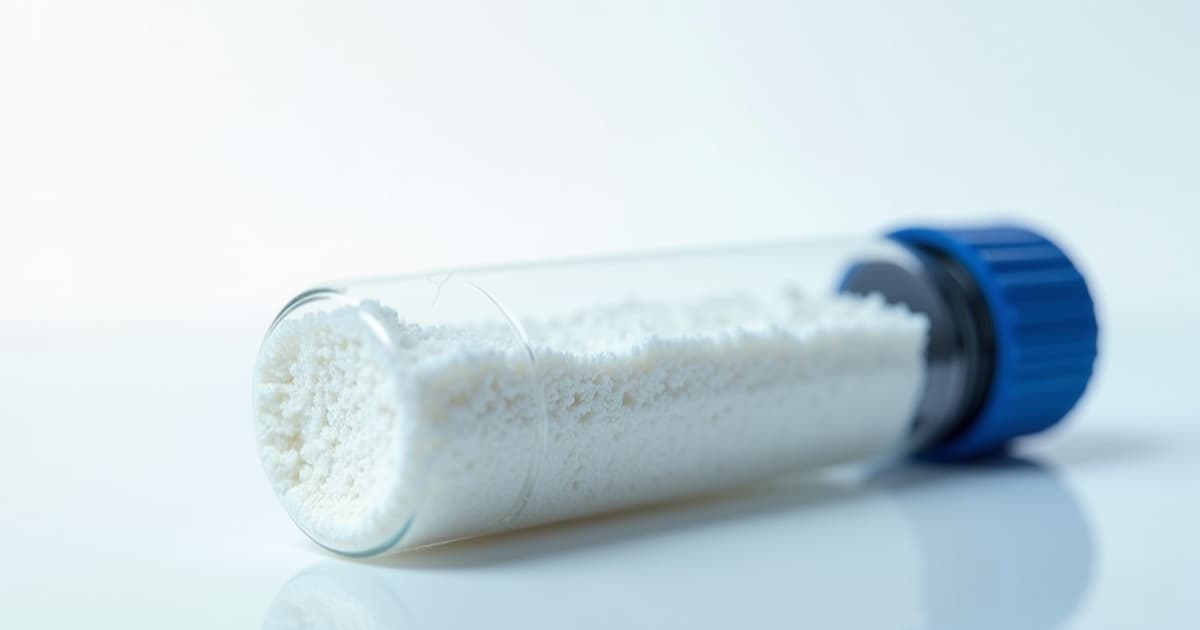
From the certificate, not from looking. A substantial, obviously visible cake in a vial labelled 5 mg is suggestive, because five milligrams of peptide alone is usually a faint film rather than a solid plug — but appearance is weak evidence and depends on the vial and the freezing conditions.
The reliable answer is the composition section of the certificate. A declared excipient appears there with an amount. If nothing is declared and the net peptide content plus counter-ion plus water roughly accounts for the fill mass, there is probably nothing else present.
Does an excipient mean the material is lower quality?
No, and this is the most common misreading. A bulking agent says something about the fill size and the drying process, not about the purity of the peptide in it. Purity is measured on the peptide-related material and an excipient does not enter that figure at all — mannitol does not absorb at 214 nm and is not integrated into the chromatogram.
What it does affect is the mass arithmetic, which is a different thing from quality and matters just as much.
What it changes in practice
Three things, and only the first affects most work.
The mass is not the peptide. This is already true because of counter-ion and residual water; an excipient makes the gap wider. Net peptide content is the figure to calculate from, and where an excipient is present that figure can be considerably below the usual 70–90%.
Some assays notice. A sugar-based lyoprotectant is invisible in most work and very visible in anything measuring carbohydrate. Buffer salts set the pH of the reconstituted solution whether or not you intended to choose one, which can matter when solubility depends on being away from the isoelectric point.
Osmolarity shifts. Where a solution is going into a cell system, a few milligrams of mannitol per millilitre is not nothing. It is usually tolerable and it is occasionally the explanation for an effect in a vehicle control nobody expected.
Should an excipient be included in a vehicle control?
Yes, if one is present and the work is sensitive enough to care. A vehicle control exists to subtract everything that is not the peptide, and an excipient is part of that. The practical difficulty is that reproducing it means knowing the amount, which brings the question back to whether the certificate declared it.
Where the amount is unknown and the assay is sensitive, the more reliable move is a comparison across two lots with different excipient loads rather than an attempt to reconstruct the vehicle.
Does an excipient interfere with the purity figure?
No, and this is worth being precise about because it cuts both ways. Mannitol and the sugars do not absorb meaningfully at 214 nm, so they are not integrated into the chromatogram and do not inflate or deflate the purity percentage. A 99% figure on an excipient-containing vial means 99% of the peptide-related material, exactly as it would otherwise.
What they do affect is any measurement made on total mass. Weighing out a portion of the powder and assuming it is peptide is wrong by the excipient fraction as well as the counter-ion and water fractions, which is why content is reported separately and why it can be much lower than people expect.
Why fill size decides whether one is needed
The threshold is not a property of the peptide; it is a property of how much solid is dissolved in the volume being frozen. A vial filled with 2 mL of solution containing 10 mg of total solids is around 0.5% solids, which is below where a self-supporting cake reliably forms.
That is why larger fills often need no excipient while smaller ones do. A 10 mg fill frozen in a small volume carries enough mass to hold its own structure; a smaller fill of a short peptide frequently does not, and the manufacturer either adds a bulking agent or accepts a film.
Neither choice is wrong. A film is cosmetically unimpressive and dissolves perfectly well. A cake looks like what people expect and costs a little mass accuracy. The thing that matters is whether the certificate tells you which you have.
Does an excipient affect how the vial should be stored?
Mildly, and in a direction worth knowing. Mannitol crystallises during freezing, which produces a mechanically firm cake and leaves the peptide in the spaces between crystals. Sugars such as sucrose and trehalose stay amorphous instead, forming a glass that physically immobilises the peptide — which is the mechanism behind their use as lyoprotectants.
An amorphous matrix is more protective and more sensitive to moisture: taking up water lowers the temperature at which the glass softens, and a softened matrix no longer immobilises anything. So a sugar-containing vial has a slightly stronger reason than usual to be brought to room temperature before opening rather than opened cold.
Can an excipient be removed before use?
In principle, by desalting or buffer exchange, and in practice it is rarely worth it at research scale. Both operations lose material, both add a step where adsorption to surfaces can take a measurable fraction of a dilute peptide, and the quantities involved are usually small enough that the excipient was never the problem.
The exception is an assay where the excipient genuinely interferes and cannot be controlled for — a carbohydrate readout against a sugar lyoprotectant being the clearest example. There, sourcing an excipient-free lot is simpler than removing one. A short peptide supplied without a bulking agent is usually available if asked for specifically.
Does an excipient change how the vial reconstitutes?
Usually for the better. A well-formed cake with a high internal surface area dissolves faster and more evenly than a dense film pressed against the glass, which is part of why bulking agents are used at all. Mannitol in particular dissolves quickly and does not thicken the solution.
What it does not change is the technique. Solvent down the vial wall, gentle swirling, no vortexing applies the same way, and a solution that looks cloudy after an excipient-containing cake dissolves is as much a signal as it would be otherwise.
How should an excipient be handled in a write-up?
Named, with its amount, in the same place the peptide is described. A methods section stating the compound, the lot and the supplier but not the formulation has omitted part of what was added to the system, and it is the part a reader attempting to replicate would most easily miss.
Where the amount is not declared on the certificate, say that instead of guessing. "Supplied as a lyophilised solid; formulation not disclosed" is an honest and useful sentence, and it tells a future reader why a difference between their material and yours might exist.
The same applies to the counter-ion, which is an excipient in everything but name — it was not added deliberately but it is present, it is mass, and it is not inert in every assay. Recording the salt form alongside the compound costs four words and settles a question that otherwise cannot be reopened.
Does the presence of an excipient need to be disclosed?
It should be, and its absence from a certificate is a reasonable question rather than a defect to assume. A formulation is part of what the buyer received, and a composition section that accounts for the fill mass is the normal way to state it.
Where a supplier does not declare one, the arithmetic is the check: net peptide content plus counter-ion plus water, compared against the stated fill. A gap suggests something else is present.
All products referenced here are supplied for laboratory and research use only. They are not drugs, foods, supplements or cosmetics, and are not for human or veterinary use.